
CADD Launch Explained: Canada’s First Regulated CAD-Backed Stablecoin (2026)
On 4 May 2026, Canada’s digital asset market reached an important milestone: Tetra Digital Group and CAD Digital launched CADD, a new payment stablecoin pegged 1:1 to the Canadian dollar. For anyone searching for clear answers on the CADD stablecoin Canada story, the headline is simple: this is the first CAD-backed stablecoin issued by a regulated trust company and approved by Alberta Treasury Board and Finance.
That matters because CADD brings Canadian dollars onto programmable blockchains in a more structured, compliance-focused way than earlier attempts. It is live on Base, Ethereum and Tempo, with Solana support expected soon. For retail users, fintechs and institutions alike, CADD could improve settlement speed, unlock on-chain CAD liquidity and fit more closely with the direction of CADD regulation Canada. If you are also exploring where to access digital assets more broadly, CoinixPro’s guide to best crypto platforms in Canada is a useful starting point.
Quick take: the key points at a glance
- CADD is a CAD-backed stablecoin fully backed 1:1 by Canadian dollars.
- It is issued by Tetra Trust Company through CAD Digital Inc.
- It has approval from Alberta Treasury Board & Finance, making it the first regulated CAD stablecoin of its kind.
- CADD is live on Base, Ethereum and Tempo, with Solana integration coming soon.
- Its main focus is institutional settlement, cross-border payments and programmable treasury operations.
What CADD is and why this Canadian stablecoin launch matters
A stablecoin is a crypto asset designed to hold a steady value, usually by being linked to a fiat currency such as the Canadian or US dollar. The most common model is fiat-backed, where each token is supported by reserves held off-chain. That is different from algorithmic stablecoins, which try to maintain a peg through code and market incentives rather than full cash backing.
CADD is a CAD-backed stablecoin pegged 1:1 to the Canadian dollar. According to the brief, funds used to mint CADD are held in trust and dedicated exclusively to redemption. In practical terms, the goal is straightforward: one CADD should be redeemable for one Canadian dollar at par.
This Canadian stablecoin launch is significant because CADD is issued by Tetra Trust via CAD Digital Inc., giving it a structure that already aligns with the direction of Canada’s upcoming stablecoin framework. That combination of legal oversight, trust-held reserves and blockchain-based settlement is what sets Tetra Digital Group CADD apart from many earlier digital dollar projects.
How CADD works across Base, Ethereum, Tempo and soon Solana
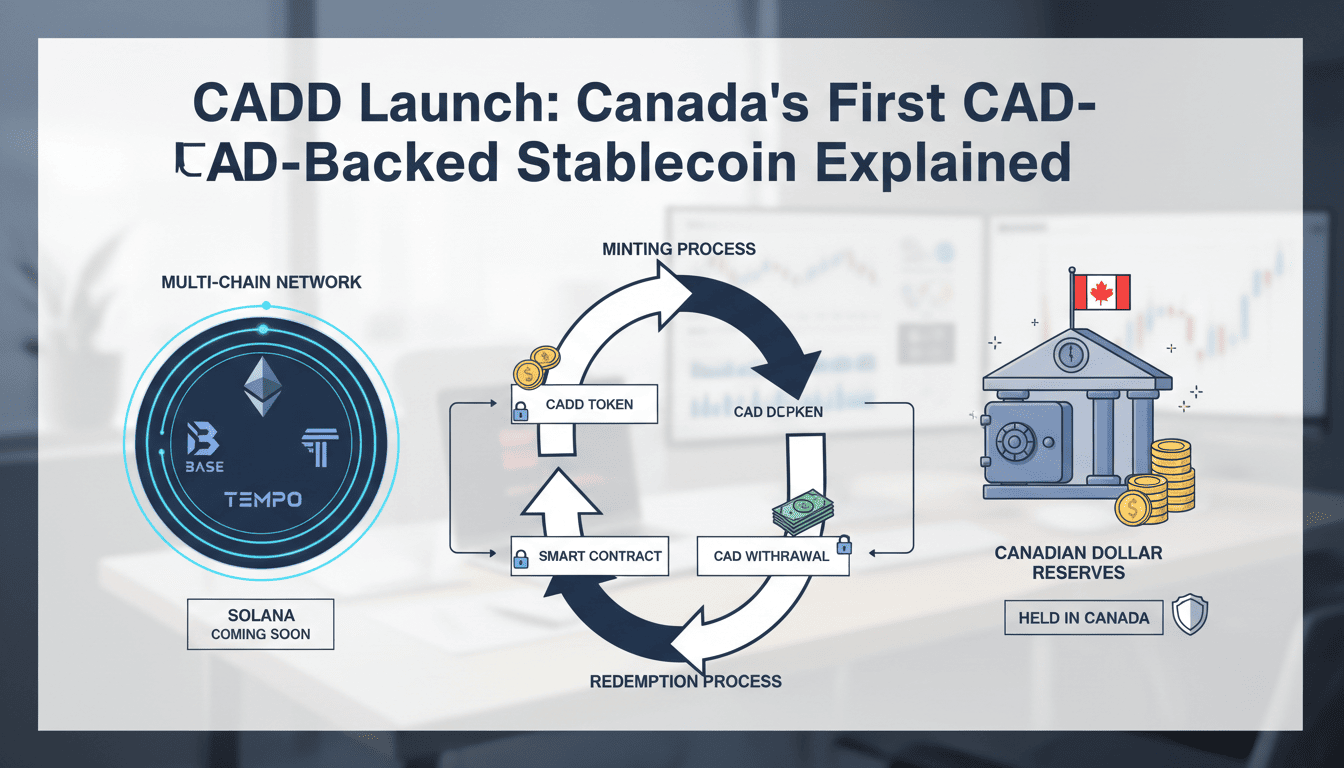
CADD is built for interoperability across multiple chains rather than being limited to a single network. At launch, the token is available on Base, Ethereum mainnet and Tempo, with Solana support expected next. That multi-chain setup is important because different users need different trade-offs. Ethereum offers deep liquidity and broad infrastructure, Base can reduce costs and improve speed, while additional chains may expand payment and treasury use cases over time.
From an operational perspective, CADD tokens are minted and redeemed through CAD Digital’s smart contract system. When eligible users deposit Canadian dollars, new tokens can be issued; when tokens are redeemed, the corresponding fiat amount is returned and the tokens are removed from circulation. The reserve assets are held in Canada, which supports the domestic focus of the project.
The launch also emphasizes transparency and control. CADD is positioned with on-chain proof of reserves, regular attestations and the custody experience of Tetra Trust. That matters because reserve confidence is central to any stablecoin. For users evaluating a Base Ethereum Solana stablecoin strategy, the key question is not just where the token lives, but how reliably it can be redeemed and monitored.
The regulatory backdrop: Bill C-15, Alberta approval and CADD regulation Canada
The legal context behind CADD is one of the main reasons it stands out. In Budget 2025, Canada introduced a forthcoming Stablecoin Framework through Bill C-15. The broad goal is to create clear rules for fiat-referenced crypto assets so that Canadians can use them with stronger safeguards around reserves, governance and redemption rights.
Under the framework described in the brief, issuers will be expected to maintain proper reserves, provide redemption at par and register with the Bank of Canada. The legislation is also meant to improve corporate governance and data-security standards, reducing some of the weaknesses that have historically affected parts of the global stablecoin market.
The timeline matters too. Draft regulations are expected to be developed over roughly 12 to 18 months from early 2026, with the full framework likely coming into force in 2027. That means Canada is still in a transition period, but the policy direction is increasingly clear.
Within that context, CADD appears designed to fit the future rules rather than react to them later. Its 1:1 reserve model, trust company issuance and redemption-at-par structure line up closely with the framework’s core requirements. The Alberta stablecoin approval attached to the launch adds another layer of credibility, especially for institutions looking for legal certainty before adopting on-chain settlement tools.
The issuer behind CADD: Tetra Digital Group and its ecosystem partners
Tetra Digital Group CADD is not a standalone experiment. It comes from a broader corporate structure that includes Tetra Trust and CAD Digital. Tetra Trust already has a notable position in Canada’s crypto market as the country’s first regulated digital asset custodian, and it has also supported staking-enabled ETFs. That experience is relevant because stablecoin success depends as much on operational trust and custody discipline as it does on token design.
The consortium supporting CADD includes Urbana Corporation, Wealthsimple, Purpose Unlimited, Shakepay, ATB Financial, National Bank of Canada and Shopify. These names matter because adoption rarely comes from technology alone. Liquidity, payment flows, treasury integration and market confidence usually depend on established financial and commercial relationships.
For institutions, this partner network suggests that CADD is meant to be usable within the Canadian financial ecosystem, not just tradable on-chain. That is a major difference between a niche token and a serious settlement product.
Why institutions care: settlement, treasury and on-chain CAD liquidity
The clearest use case for CADD is faster movement of Canadian dollars between businesses and financial counterparties. Traditional payment rails often involve banking-hour limits, settlement delays and cross-border friction. A regulated CAD-backed stablecoin changes that by making CAD value available on-chain around the clock.
Here is a simple breakdown of where CADD could matter most.
| Use case | How CADD helps | Why it matters |
|---|---|---|
| Cross-border settlement | Enables 24/7 transfer of CAD value on-chain | Reduces delays linked to correspondent banking |
| Corporate treasury | Supports real-time transfers between entities or partners | Improves cash management and settlement timing |
| Marketplace payouts | Allows programmable disbursements through smart contracts | Can simplify automated payment flows |
| Fintech settlement | Enables direct value transfer between approved participants | Lowers operational friction and reconciliation time |
| DeFi and trading liquidity | Creates potential CAD-denominated pools and pairs | Expands on-chain trading options beyond USD stablecoins |
The broader significance is that CADD may help build native CAD liquidity in digital markets that have long been dominated by US-dollar stablecoins. If DeFi protocols, centralized exchanges and decentralized exchanges begin offering CADD pairs, Canadian users could move in and out of positions without taking unnecessary USD currency exposure first.
Even for consumers, the benefits could be meaningful over time. More efficient infrastructure at the institutional layer can lead to faster transfers, more competition among payment providers and new products built around programmable money. Retail access is not the primary focus at launch, but the downstream effects could still be substantial.
How Canadians may get and store CADD safely
At launch, CADD is aimed mainly at institutional and enterprise users. That means many retail Canadians may not be able to access it immediately in the same way they buy more established stablecoins. Over time, though, access could expand through regulated exchanges, wallets, fiat on-ramps or DeFi pools, depending on how listings and compliance pathways develop.
For Canadians who want to prepare, the likely access routes are relatively familiar:
- regulated crypto platforms that choose to list CADD
- approved fiat on-ramps connected to CAD Digital or partners
- decentralized exchange pools on supported chains
- enterprise or treasury platforms integrating CADD for payments
Storage will depend on the network version you use. Because CADD is launching on Base and Ethereum, users would generally need wallets that support ERC-20 assets on those networks. Solana support, once live, would add another wallet ecosystem. If you need a refresher on safe self-custody, CoinixPro’s guide to crypto wallet security Canada covers the basics of hot vs cold storage and what to consider before holding tokens yourself.
For platform selection, security and compliance should come before convenience. Use regulated providers where possible, complete KYC and AML steps when required, and double-check network compatibility before transferring assets. If you are comparing venues, CoinixPro’s resource to compare crypto exchanges can help you evaluate your options more carefully.
CADD vs USDC, USDT and other stablecoins
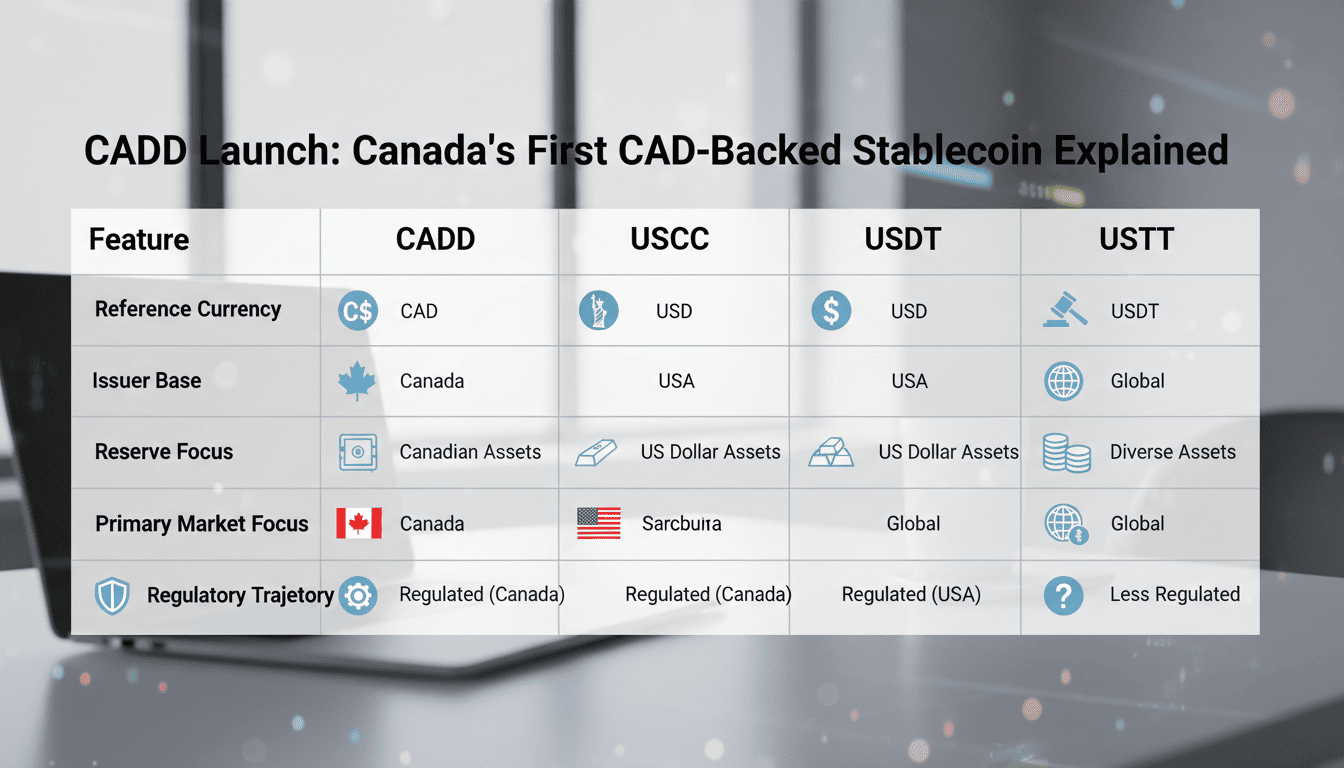
Most of the stablecoin market today is built around the US dollar, with USDC and USDT dominating trading and settlement activity. CADD shares the basic mechanics of those products: blockchain-based tokens, reserve backing and expected 1:1 redemption. The major difference is the currency and legal structure.
The comparison below highlights where CADD stands apart.
| Feature | CADD | USDC / USDT style stablecoins |
|---|---|---|
| Reference currency | Canadian dollar | US dollar |
| Issuer base | Canadian regulated trust structure | Generally non-Canadian issuer structures |
| Reserve focus | Held in Canada and dedicated to redemption | Varies by issuer and jurisdiction |
| Primary market focus | Institutional settlement and CAD liquidity | Global trading, payments and crypto liquidity |
| Regulatory trajectory | Designed to align with Canada’s stablecoin framework | Subject to their own home-jurisdiction frameworks |
There have been other Canadian-dollar token efforts in the market, but CADD’s distinction in this brief is its regulated trust company issuance and provincial approval. That gives it a different profile from generic CAD tokens that may exist without the same level of official backing.
Risks, tax treatment and what to watch next
Key risks and considerations
Stablecoins are designed for price stability, but they are not risk-free. CADD still depends on smart contracts functioning correctly, reserve management remaining sound and supported blockchains operating smoothly. Network congestion can delay transfers, and market adoption is never guaranteed. Regulatory developments could also change how access, listing or custody works over time.
That said, CADD’s structure reduces some of the most obvious concerns. Reserves are held in trust, redemption is central to the model and the project is being launched with regulatory alignment in mind. Even so, users should understand an important distinction: CADD is a private stablecoin, not a central bank digital currency. It should not be confused with any future government-issued digital Canadian dollar.
Tax and legal implications for Canadians
For tax purposes, stablecoins are generally treated like other crypto assets in Canada. Depending on how they are used, transactions can result in capital gains, capital losses or business income. If someone acquires CADD, uses it in trading, redeems it or spends it in a taxable context, the transaction may need to be recorded and reported.
Good record-keeping is essential. Canadians should track the date, time, amount, CAD value and purpose of each transaction, including purchases, redemptions and transfers. Moving stablecoins between wallets you personally own is generally not considered a taxable disposition under CRA rules, but those transfers should still be documented to preserve an accurate audit trail. Readers looking for broader tax guidance should monitor CoinixPro’s future Crypto Tax Canada resources as they become available.
The future outlook for regulated stablecoins in Canada
Looking ahead, CADD could be an early signal of how Canada’s digital money market evolves through 2027 and beyond. As the federal stablecoin framework takes shape, more issuers may explore CAD-backed products with stronger reserve controls and clearer redemption rights. That could help Canada develop its own on-chain liquidity ecosystem rather than relying almost entirely on USD-denominated rails.
The wider landscape is also moving. The Bank of Canada has explored wholesale CBDCs and tokenized financial infrastructure, including initiatives such as Project Samara. If those efforts continue, regulated private stablecoins and central bank projects may end up serving different but complementary roles. A wholesale or retail CBDC would have a public-sector function; products like CADD could continue to power commercial settlement, marketplace payouts and digital asset trading.
Whether CADD succeeds at scale will depend on banking partnerships, legal clarity and real demand for CAD-denominated DeFi and payments. Still, the launch suggests Canada is moving from theory to practical implementation. That makes the CADD stablecoin Canada story worth following closely.
Conclusion
CADD marks a major step for digital finance in Canada. As the first regulated CAD-backed stablecoin described in this launch, it combines near-instant settlement, trust-based reserves and a structure that aligns with Canada’s emerging legal framework. For institutions, it could improve payments and treasury workflows; for the broader market, it may open the door to deeper on-chain CAD liquidity. To stay prepared, explore CoinixPro’s guides on crypto wallet security Canada and best crypto platforms in Canada, and keep watching how stablecoin regulation develops across Canada.


