
The market for tokenising AI firms is moving from niche experiment to closely watched trend in 2026. Crypto platforms are offering tradable tokens tied to private companies such as OpenAI, Anthropic and SpaceX, giving global investors a new way to speculate on pre-IPO growth. Interest has risen quickly: The Japan Times reports that trading activity on venues Ventuals and PreStocks has climbed more than threefold since the start of the year. That surge raises a bigger question for crypto users and regulators alike: what exactly are people buying, and what risks are they taking on?
Why tokenising AI firms has become one of crypto’s most talked-about themes
The appeal is easy to understand. Leading AI firms remain private, valuations are high, and direct access is limited to insiders, institutions and select private-market investors. For retail traders and many non-US investors, the door has largely been closed. Tokenised exposure changes that narrative by packaging economic interest into a crypto-native format that can be listed, transferred and traded far more easily than traditional private shares.
That is a big reason the crypto market in 2026 is paying such close attention. According to The Japan Times report on the booming crypto shadow market around private AI companies, activity on Ventuals and PreStocks has surged more than threefold since the start of the year. The same report notes that major crypto exchanges have also started listing these assets, pushing the idea beyond specialist corners of the market and into the mainstream trading conversation.
For traders, the pitch is powerful: get exposure to companies that are shaping the future of AI before any public listing event. For platforms, the model opens a new category of crypto products tied to names that already carry enormous brand value. For the broader market, though, this trend blurs the line between digital assets, synthetic instruments and regulated securities.
That tension is what makes tokenising AI firms such a compelling subject. It sits at the intersection of three forces driving investor attention in 2026:
- strong demand for AI-linked assets;
- crypto’s push to tokenize real-world and off-chain assets;
- the search for pre-IPO access in a market where private valuations can move faster than public ones.
Anyone following this space should not treat all offerings as identical. Some platforms claim direct share backing, while others may only provide contractual or synthetic exposure. That distinction matters more than the marketing headline.
What pre-IPO AI tokens actually represent
The phrase “tokenised shares” sounds straightforward, but in practice the structure can vary. In the cleanest version, a platform issues a token that is backed 1:1 by an underlying share, or by a legally defined claim on that share held through a custodian or special-purpose arrangement. In looser models, the token may track the value of the private company without granting any meaningful shareholder rights at all.
That is why the concept of 1:1 equity-backed tokens deserves careful attention. As explained in this guide to 1:1 equity-backed tokens and ownership verification, the key questions are whether each token is actually backed by a corresponding asset, how ownership is documented, and whether holders can verify that backing rather than relying on a vague promise from an issuer.
For private AI company tokens, that can become especially complicated because private shares are not always freely transferable. Shareholder agreements, company approval rights, lock-up provisions and jurisdiction-specific securities rules may affect how any “backing” is structured. A token may therefore represent one of several things:
- a direct beneficial interest in a share held by a custodian;
- an indirect claim through a special-purpose vehicle;
- a contractual right linked to the share’s value;
- or a synthetic instrument whose price is merely referenced to a private valuation.
These are very different products, even if they trade under similar tickers or are described with similar language. Before buying, investors need to know whether they are acquiring equity exposure, a redemption claim, a derivative-like payoff, or simply market sentiment packaged as a token.
The table below shows the practical differences between common structures in this fast-growing segment.
| Structure | What the token may represent | Main advantage | Main risk |
|---|---|---|---|
| 1:1 equity-backed token | A corresponding share or beneficial interest held in custody | Closer link to a real underlying asset | Verification, transfer restrictions and legal complexity |
| SPV-based token | Claim on an entity that holds private shares | Can make access operationally simpler | Extra counterparty and governance layers |
| Synthetic token | Contractual or market-based exposure to valuation changes | Often easier to list and trade | May provide no actual ownership rights |
For a trader, the difference between these structures is not academic. It affects pricing, legal enforceability, liquidity during stress, and the chances of recovering value if the issuer or intermediary fails. If you plan to trade on CoinixPro or compare similar tokenised products elsewhere, start by reading the token documentation with the same care you would give to a prospectus or term sheet.
Why demand is so strong in the crypto market in 2026
The current enthusiasm is being driven by more than curiosity. Tokenised AI exposure compresses several popular investment narratives into a single instrument: artificial intelligence growth, venture-style upside, and 24/7 crypto trading. For many market participants, that is a highly attractive combination.
There are several reasons demand has accelerated so quickly.
Private AI companies are seen as scarce assets
OpenAI, Anthropic and other leading firms are viewed as strategic companies with unusually high growth potential. Because shares are difficult to access through conventional channels, anything that appears to widen access tends to draw immediate attention.
Crypto traders are comfortable with tokenised wrappers
The market has already become familiar with stablecoins, tokenised treasuries and other real-world asset products. Against that backdrop, tokenising AI firms feels like a logical next step, even if the underlying legal and operational challenges are much tougher.
Pre-IPO narratives are naturally speculative
Private-market valuation stories can move quickly, especially around fundraising rounds, strategic partnerships or product milestones. In crypto, where speculative narratives spread fast, a token linked to a well-known AI company can attract momentum traders even when the underlying data is limited.
Global access matters
In English-speaking markets outside the narrow circle of private placements, there is broad interest in alternatives to traditional venture access. Traders in the USA, Canada, the UK and beyond are looking for ways to participate in major technology themes without waiting for a distant IPO.
Still, demand alone does not validate product quality. In fact, the faster this category grows, the more important due diligence becomes. Investors should assume that marketing language may oversimplify what they are actually buying.
How to evaluate tokenised AI company exposure before you buy
If you are considering pre-IPO AI tokens, the most useful approach is to separate the company story from the token structure. A great business does not automatically make for a sound token. The practical test is whether the product gives you transparent, enforceable and fairly priced exposure.
Here are the main checks to make before committing capital.
- Confirm the backing model. Is the token claimed to be 1:1 backed, SPV-based, or synthetic? If the answer is vague, treat that as a warning sign.
- Look for ownership verification. The stronger products explain how the underlying shares are held and how token holders can verify that the assets exist, consistent with the verification standards discussed in the Jarsy explainer.
- Understand your rights. Do you receive any voting, dividend, redemption or conversion rights? In many cases, the answer may be no.
- Check transfer and redemption terms. A token may trade freely on-platform while the underlying share remains restricted. That mismatch can create serious stress if redemptions surge.
- Review jurisdiction and compliance disclosures. Cross-border access does not eliminate securities law concerns. It often complicates them.
- Assess liquidity realistically. A listed token can still be thinly traded, highly volatile or dependent on a small number of market makers.
- Compare price to known valuation references. Premiums can become extreme when hype outpaces transparent underlying information.
The table below offers a simple framework for screening products in this category.
| Due diligence question | Why it matters | What to look for |
|---|---|---|
| Is there real asset backing? | Determines whether the token reflects actual ownership or only synthetic exposure | Clear documentation of custody or SPV holdings |
| Can ownership be verified? | Reduces reliance on issuer claims alone | Audits, attestations, legal structure details |
| What rights does the holder have? | Shapes the token’s true economic value | Transparent terms on redemption and corporate actions |
| How liquid is the market? | Affects entry, exit and slippage risk | Consistent volume, visible order books, credible market support |
| What are the legal constraints? | Private securities can face transfer and resale restrictions | Jurisdiction-specific disclosures and compliance language |
This kind of checklist helps filter out weak products that rely on branding rather than substance. If you want to compare digital-asset markets more broadly, you can learn more on CoinixPro and use the same discipline you would apply to any higher-risk instrument: understand the wrapper, not just the story inside it.
The biggest risks behind the “shadow” market for AI tokens
The phrase “shadow market” is not just dramatic wording. It captures the reality that tokenised private-company exposure often operates in the space between investor demand and traditional market infrastructure. That creates several layers of risk that may not be obvious from a trading screen.
Ownership and verification risk
A token may be advertised as backed by shares, but unless holders can verify the arrangement, they are relying on the issuer, custodian and legal chain behind the product. The Jarsy material on 1:1 equity-backed tokens highlights why proof of backing and clarity around ownership are central issues, not optional extras.
Liquidity risk
Even if interest is high, liquidity can disappear quickly. A private-company token is not the same as a listed stock with deep institutional market-making. Spreads may widen sharply during volatility, and prices can detach from any plausible underlying valuation.
Valuation risk
Private firms do not have continuously quoted public-market prices. That means token prices may be influenced by stale funding-round headlines, rumors, or momentum trading rather than robust valuation data. In hot markets, premiums can become detached from economic reality.
Counterparty and platform risk
When investors buy one of these products, they may be exposed not just to the underlying company but also to the exchange, issuer, custodian, SPV operator and legal administrator. If any one of those links fails, token holders may face delays, disputes or losses.
Regulatory risk
This is one of the most important unknowns for the crypto market in 2026. Private securities, token wrappers, cross-border distribution and retail access can trigger serious legal questions. Rules may differ across the USA, Canada, the UK and other jurisdictions, and platforms may adapt product structures in response. Traders should assume that availability, marketing and redemption mechanics could change quickly.
In practical terms, investors should treat tokenised AI exposure as a high-risk, specialist product rather than a simple substitute for owning a public stock. A well-known underlying company does not remove wrapper risk.
How these tokens compare with other ways to get AI exposure
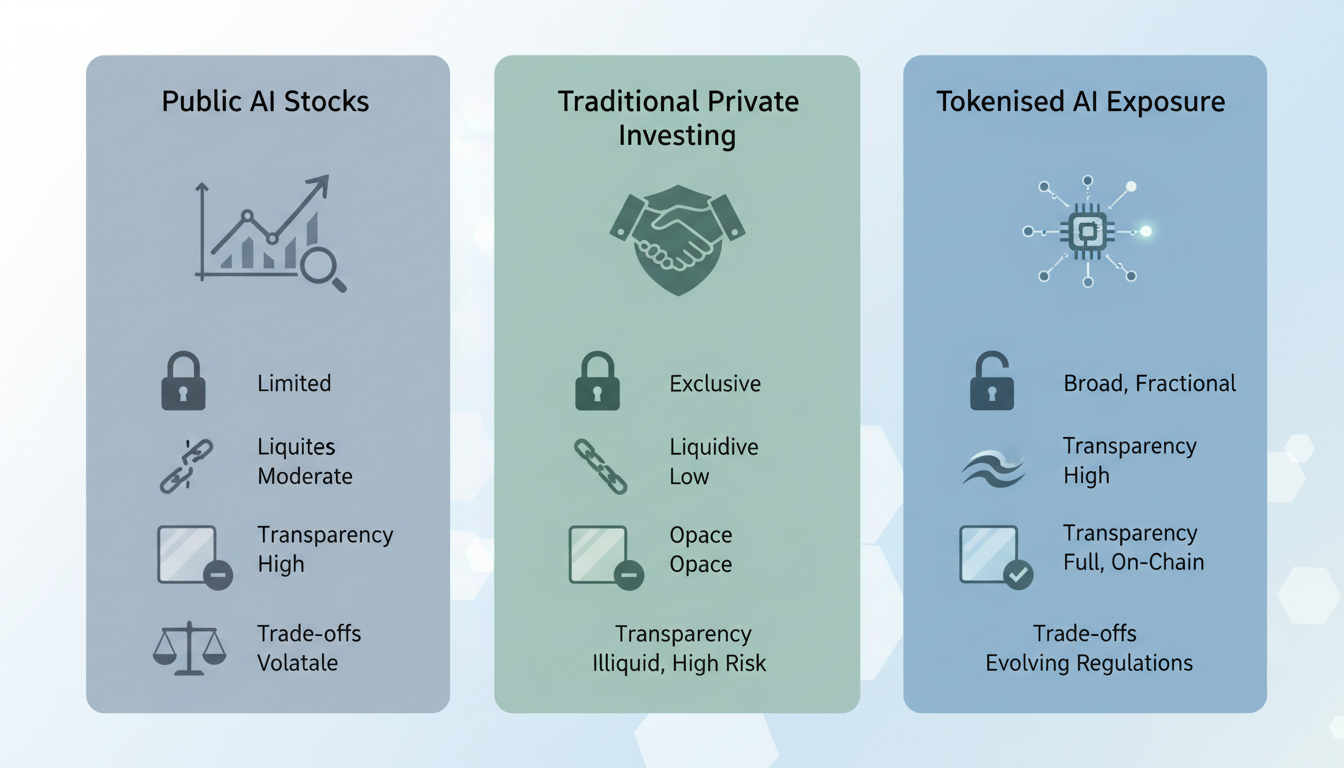
Tokenising AI firms is only one path for investors who want exposure to the sector. Whether it makes sense depends on your goals. If you want pure liquidity and simpler regulation, public AI-related equities may still be easier to understand. If you want venture-style upside and are prepared for complex risk, pre-IPO tokens may look more attractive.
The table below compares the main options at a high level.
| Route to AI exposure | Access | Liquidity | Transparency | Typical trade-off |
|---|---|---|---|---|
| Public AI-related stocks or ETFs | Broadly accessible | Usually higher | Generally stronger | Less direct exposure to elite private firms |
| Traditional private-market investing | Often limited to eligible investors | Low | Varies | Closer to real private equity, but hard to access |
| Tokenised private AI company exposure | Potentially broader via crypto platforms | Variable | Highly structure-dependent | Easier access, but higher wrapper and legal risk |
The comparison shows why these products are generating so much attention. They promise access and tradability that conventional private markets rarely offer. But that convenience comes with structural uncertainty. For many investors, the right move is not to avoid the category entirely, but to size positions modestly and choose only the most transparent offerings available on a reputable CoinixPro platform or comparable venue.
What tokenising AI firms could mean for crypto beyond 2026
This trend matters beyond the immediate excitement around OpenAI, Anthropic or SpaceX-linked products. If tokenising AI firms proves durable, it could accelerate a broader shift in how high-demand private assets are distributed and traded. Crypto infrastructure has long promised more open market access; tokenised private-company exposure is one of the clearest tests of that promise.
There are two possible paths from here. In the optimistic scenario, platforms improve disclosures, standardize proof-of-backing practices, tighten custody arrangements and work within clearer legal frameworks. That would move the market away from the “shadow” label and toward something more mature and investable.
In the less favorable scenario, hype outruns structure. Investors chase famous names, issuers rely on opaque backing models, and regulatory pressure increases after disputes over ownership, liquidity or investor protections. If that happens, the sector may still survive, but likely in a more restricted and more heavily supervised form.
For traders and long-term investors alike, the practical lesson is simple: focus on the plumbing. In tokenised markets, the wrapper is often as important as the asset itself. That is especially true when the asset is a private AI company with limited public information and complicated transfer rules.
Tokenising AI firms is one of the clearest examples of how the crypto market in 2026 is stretching beyond native digital assets into harder-to-access corners of finance. The opportunity is obvious: broader participation in some of the world’s most sought-after private companies. The risks are just as real, from weak ownership verification to liquidity and regulatory uncertainty. Investors who approach this space with discipline, skepticism and careful product analysis will be far better positioned than those buying on headline appeal alone.


