
Binance Could Lose EU Licence Under MiCA — What’s Next?
Binance and the MiCA challenge
Binance is facing a fresh regulatory test in Europe as the end-June MiCA deadline approaches. According to a Reuters report dated 16 June 2026, sources said the Greek securities regulator intends to reject the exchange’s application for a Markets in Crypto-Assets licence. That makes the binance EU licence MiCA issue one of the most closely watched regulatory stories in crypto this month.
A MiCA licence matters because it determines whether a crypto-asset service provider can operate across EU member states under a harmonised framework. For readers tracking crypto news, the potential refusal is headline-worthy not only because Binance is a major global exchange, but because MiCA regulation is becoming a defining test of how large platforms handle compliance, client access and cross-border oversight.

What happened: Reuters report on the licence rejection
Reuters reported on 16 June 2026 that Binance’s application in Greece appears set to be rejected, citing sources familiar with the matter. Under MiCA regulation, exchanges and other crypto-asset service providers need an EU crypto licence to continue serving clients inside the bloc. A licence granted in one member state can support operations across the wider EU, making the choice of national regulator commercially significant.
The reported issue centres on the Greek regulator crypto licence process. If the application is refused and no alternative authorisation is secured by the MiCA deadline at the end of June 2026, Binance would have to stop serving EU clients from within the bloc. That would be a material change for European customers who use the platform for spot trading, Bitcoin and Ethereum markets, Euro-pegged stablecoins such as EURt, and other exchange services.
Binance has said it has complied with the process but had not received official word, according to the briefed Reuters account. That distinction matters. A reported intention to reject is not the same as a final public decision. Until Binance or the relevant regulator confirms the outcome, the situation remains unresolved.
Even so, the report adds to wider Binance regulatory issues. Global exchanges have to manage local rules, licensing standards, governance expectations and investor-protection requirements in multiple jurisdictions at once. MiCA is designed to reduce fragmentation inside the EU, but the approval process still depends on national competent authorities, including the Greek securities regulator in this case.
MiCA and EU crypto regulation explained
MiCA, short for Markets in Crypto-Assets, is the EU’s flagship framework for crypto regulation. Its goal is to create a common rulebook across member states, replacing the patchwork of national regimes that previously shaped how exchanges, custodians and token issuers could operate.
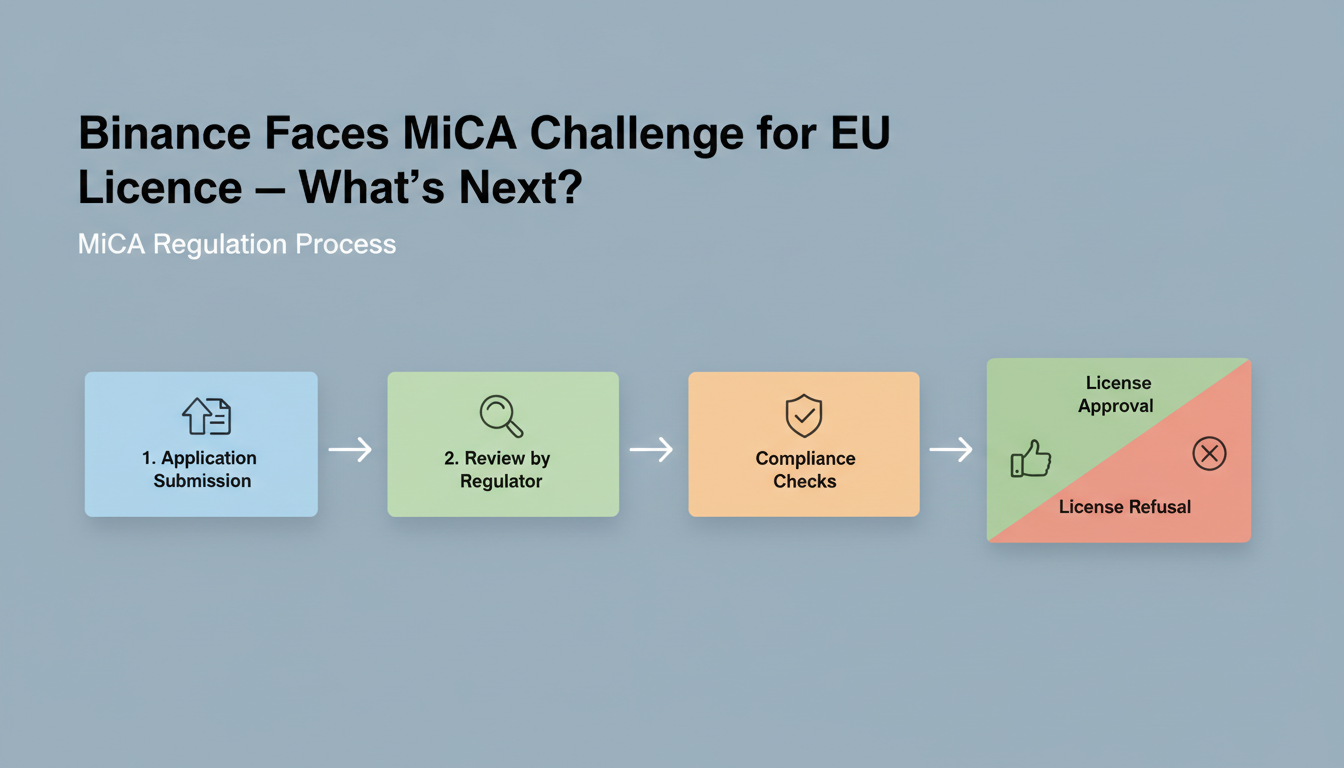
For a platform seeking an EU crypto licence, the process is not just a formality. Regulators assess areas such as governance, compliance systems, custody arrangements, capital requirements, client disclosures and investor protection. The framework also addresses stablecoins, including Euro-pegged assets, which are especially relevant for users moving between crypto and fiat-linked instruments.
A key feature of MiCA regulation is passporting. Once a provider is authorised in one EU member state, it can generally use that licence to provide services across the bloc, subject to the rules of the framework. That is why a decision by one national regulator can affect access in multiple EU markets.
There are already signs that MiCA approvals are becoming a competitive differentiator. WhiteBIT’s MiCA licence approval on 19 June 2026, through the Austrian FMA, provides useful context: some exchanges are moving through the process successfully, while others may face closer scrutiny. Custodial providers such as Coinbase, decentralised platforms and specialist venues will all be judged by how they adapt to the new compliance environment.
For broader background on crypto regulation, MiCA is best understood as part of a global shift: regulators are not trying to treat crypto as a niche experiment anymore. They are building licensing systems around how platforms hold assets, manage risk and communicate with customers.
Why this news matters for Singapore traders
The immediate regulatory decision is European, but Singapore-based traders still have reasons to pay attention. Many SG traders use Binance for access to global liquidity, international pairs and markets influenced by European trading activity. If Binance is required to restrict EU clients, market depth and order flow could shift across platforms.
That does not mean Singapore users would automatically lose access because of an EU licence issue. The regulatory trigger is tied to serving European clients from within the bloc. Still, the crypto market is globally connected. A change in European participation on Binance could influence liquidity patterns, spreads, account migrations and where active traders choose to execute.
For SG traders Binance exposure is often practical rather than geographic. A Singapore-based user may trade Bitcoin, Ethereum or stablecoin pairs affected by European volumes. They may also monitor EU regulatory events because those events can shape sentiment across centralised exchanges.
Some traders may respond by reviewing local and international platform access, considering non-custodial wallets, or comparing exchange risk controls. Others may wait for official announcements before making changes. The key point is that regulatory outcomes in the EU can affect user journeys far beyond Europe, especially for traders who rely on global market infrastructure.
Regulatory trends: Europe vs Asia
Europe and Singapore are both serious about crypto oversight, but their frameworks are structured differently. MiCA aims to harmonise rules across EU member states, giving firms a route to authorisation that can cover the broader bloc. It places emphasis on licensing, investor protection, capital requirements and consistent supervision.
Singapore’s approach runs through the Monetary Authority of Singapore, which regulates digital payment token activity under its local framework. MAS rules focus on licensing, consumer safeguards, anti-money laundering controls and the responsibilities of firms offering crypto-related services in Singapore.
The practical difference is scale and passporting. In Europe, one EU crypto licence can become a regional gateway under MiCA. In Singapore, firms must satisfy MAS requirements for activity in the Singapore market. For global exchanges such as Binance, that means compliance cannot be handled as a single universal checklist. A platform may need different permissions, structures and product availability depending on where the customer is located.
This is why international compliance has become a core business function for exchanges. A platform’s dashboard, account access, product set and onboarding flow may vary by region because the rules around derivatives, custody, deposits, promotions and investor categorisation differ. For users, the visible outcome is simple: some products are available in one country but limited in another.
The contrast between Europe and Asia also explains why SG readers should not view MiCA in isolation. EU enforcement can influence global standards, while MAS guidance can shape how platforms treat Singapore clients. Large exchanges increasingly need to prove they can meet both sets of expectations without weakening user protection.
Impact on investors, exchanges and the market
If Binance loses the ability to serve EU clients from within the bloc, the most direct impact would be on European users. They may need to move accounts, reduce activity, or use platforms with confirmed EU authorisation. That could create opportunities for other exchanges that already hold or secure MiCA approvals.
For Binance, the market impact would depend on how much European activity is affected and whether any alternative licensing route becomes available. The briefed Reuters story does not provide figures, so it would be inappropriate to estimate volume loss. What can be said is that EU user access is strategically important because Europe is a major regulated market and MiCA creates a clearer competitive boundary between authorised and unauthorised providers.
Investors may also watch for second-order effects. Liquidity can migrate when users move between venues. Stablecoin demand can shift if Euro-linked instruments are treated differently across platforms. Crypto prices may react to regulatory headlines, particularly when the affected exchange is globally recognised, though price outcomes cannot be predicted from the licensing report alone.
Centralised exchanges are likely to keep adapting through stronger compliance systems, clearer regional access controls and more transparent user communications. At the same time, some traders may explore decentralised alternatives, including perps venues such as Hyperliquid, non-custodial wallets and prediction-market platforms such as PremiumBlock. These options are not direct substitutes for every exchange function, but they may gain attention when centralised access becomes more jurisdiction-dependent.
Readers comparing regulated venues, custody models and platform availability can use our guide to the best crypto platforms as a starting point for further research.
Risks and uncertainties
Several uncertainties remain. First, the reported rejection had not been officially confirmed in the briefed account. Binance said it had complied with the process but had received no official word. Until a final decision is announced, the licence outcome remains open.
Second, the possibility of appeal, further engagement with regulators, or last-minute compliance steps cannot be ruled out based on the available information. Different national regulators may also take different views on applications under MiCA, even though the framework is designed to harmonise EU rules.
Third, market reaction may be uneven. Some users may act quickly, while others may wait for formal guidance from Binance, the Greek securities regulator, ESMA or other relevant authorities. Regulatory uncertainty often affects sentiment before it affects operations, which is why traders should separate confirmed facts from source-based reporting.
Preparing for change
The binance EU licence MiCA story is a reminder that crypto access increasingly depends on regulation, not just platform functionality. Reuters’ 16 June 2026 report suggests Binance may face rejection in Greece, while the end-June MiCA deadline raises the stakes for EU client access.
For Singapore readers, the issue is worth monitoring because global liquidity, platform choice and account planning can be affected by European regulatory decisions. Follow official announcements from Binance and EU regulators, review your exposure to centralised platforms, and use practical trading guides to understand risk controls before changing how you trade.
FAQ
What is a MiCA licence and why does Binance need one?
A MiCA licence allows a crypto-asset service provider to operate under the EU’s Markets in Crypto-Assets framework. Binance needs authorisation to continue serving EU clients from within the bloc once the MiCA deadline applies at the end of June 2026.
Will Binance stop serving EU customers if its licence is rejected?
If Binance does not secure the required EU crypto licence, the Reuters-based brief states it would have to cease serving EU clients from within the bloc. The final outcome depends on official confirmation, possible regulatory engagement and any alternative authorisation route.
How can SG traders protect themselves?
SG traders can monitor official Binance and regulator updates, avoid acting on unconfirmed claims, review where their assets are held, and understand the rules affecting each platform they use. Non-custodial wallets and regulated local options may be worth researching, depending on individual needs.
What alternatives are available if access changes?
Potential alternatives include other centralised exchanges with appropriate regional permissions, local platforms, decentralised exchanges, non-custodial wallets and specialist venues such as perps or prediction-market platforms. Suitability depends on regulation, custody preferences, fees, product access and risk tolerance.
Could other exchanges face similar MiCA issues?
Yes. MiCA applies across the EU crypto market, so other exchanges and service providers must meet licensing and compliance requirements. WhiteBIT’s MiCA licence approval through the Austrian FMA shows approvals are possible, but each application is assessed by the relevant authority.
Disclaimer: This article is for informational purposes only and is not financial, investment, legal or tax advice. Crypto markets are volatile, regulations can change quickly, and readers should conduct their own research and consult qualified professionals before acting on any information.


