
Crypto Tax Australia 2026: CGT, Staking and DeFi Rules Explained for Australian Investors
Crypto tax in Australia is not limited to selling Bitcoin for AUD. For many investors in 2026, the harder questions sit inside token swaps, staking rewards, DeFi lending, liquidity pools, wrapped assets, airdrops, wallet transfers and transaction records.
For Australian tax purposes, crypto is generally treated as an asset rather than ordinary currency. That means disposing of crypto can trigger Capital Gains Tax, while receiving certain rewards, payments or earnings in crypto can be treated as ordinary income. The Australian Taxation Office also monitors crypto activity through data matching with designated service providers, so accurate reporting is increasingly important.
This crypto tax Australia guide is written for investors, active traders, stakers and DeFi users who want a practical ATO-first explanation. It covers what is usually taxable, what may be non-taxable, how CGT is calculated, how staking and DeFi rewards are treated, what records to keep, and the common mistakes that cause reporting problems.
Crypto Tax Australia 2026: Key Takeaways
- Selling, swapping, gifting or spending crypto will usually trigger a CGT event.
- Staking rewards are usually taxed as ordinary income at their market value in AUD when received.
- If you later sell, swap or spend staking reward tokens, that later transaction can create a separate CGT event.
- Many DeFi interactions, including swaps, wrapping, lending and liquidity pool activity, can have tax consequences.
- Moving crypto between wallets you own is generally not taxable, but network fees paid in crypto can still have CGT consequences.
- Buying crypto with AUD and simply holding it is usually not taxable at the time of purchase or while you continue to hold.
- The ATO generally expects crypto records to be kept for at least 5 years.
How Is Crypto Taxed in Australia? CGT vs Income Tax
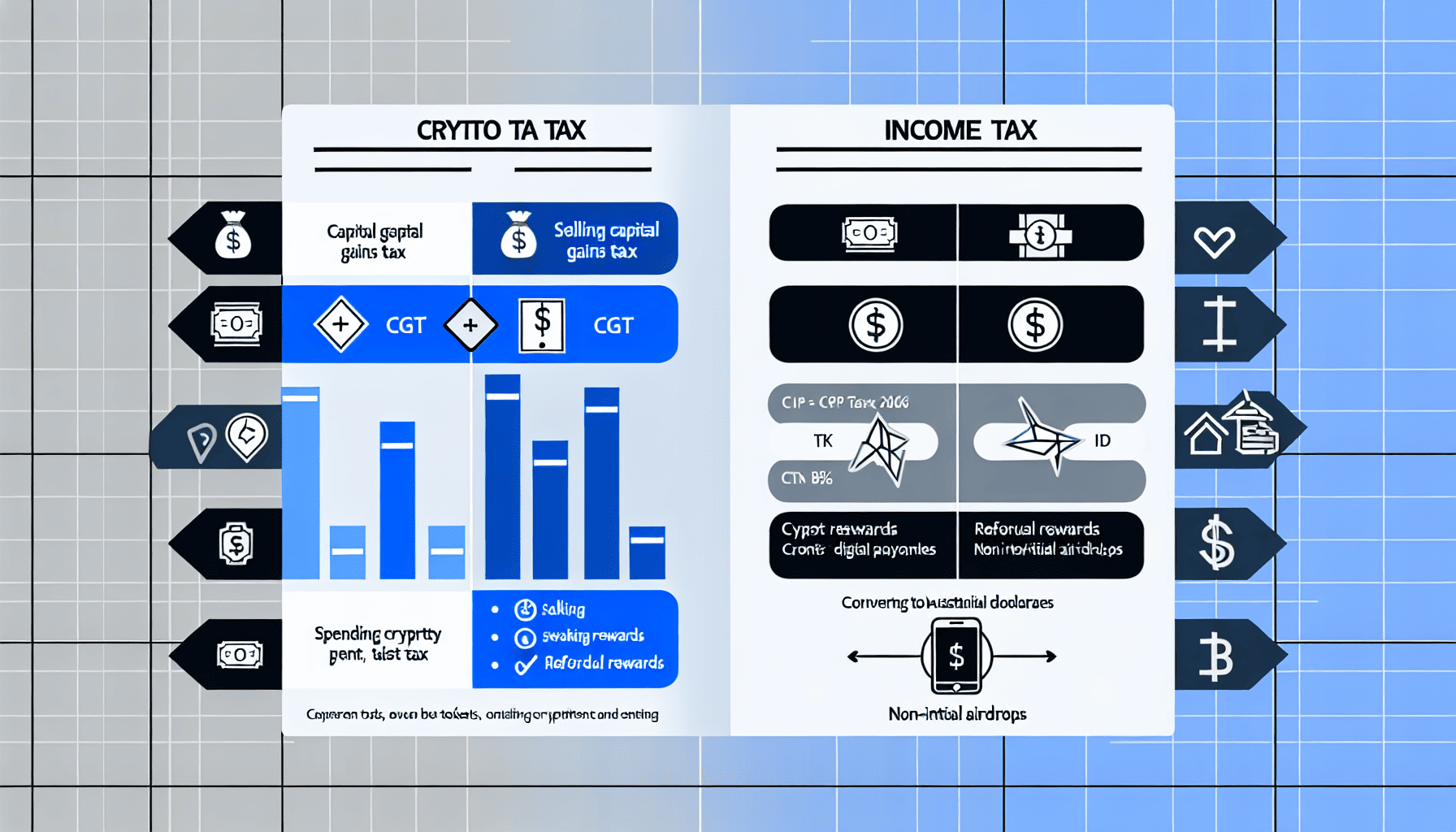
The core of ATO crypto tax treatment is the difference between Capital Gains Tax and Income Tax. Once that distinction is clear, most crypto scenarios become easier to classify.
CGT usually applies when you dispose of crypto. A disposal does not only mean cashing out to Australian dollars. It can include selling crypto, swapping one token for another, using crypto to buy goods or services, gifting crypto, converting crypto to fiat, and some DeFi transactions where one asset or right is exchanged for another.
Income tax usually applies when you receive crypto as earnings, rewards or payment. Common examples include staking rewards, some DeFi rewards, crypto received for services, interest-style returns, referral rewards and certain non-initial airdrops. In these cases, the AUD market value at the time of receipt is usually the amount that matters for income reporting.
This is why how is crypto taxed in Australia is not answered by one rule. A single token can be taxed in two different ways at two different times:
- first as income when it is received, if the receipt is taxable; and
- later under crypto CGT Australia rules when it is sold, swapped, gifted, spent or otherwise disposed of.
For example, if you receive tokens as staking rewards, the AUD value when you receive them is usually assessable income. If you later sell those tokens, the sale is a separate CGT event. Your cost base for those reward tokens will generally start with the AUD value already recognised at receipt.
That separation is central to any reliable crypto tax guide Australia investors can actually use. It is also why record-keeping is not optional. You need AUD values at receipt for income tax, AUD cost bases for CGT, and transaction evidence that supports both.
When Does Capital Gains Tax Apply to Crypto?
For most individual investors, capital gains tax crypto Australia rules apply when crypto is disposed of. The ATO commonly treats the following actions as disposals that may trigger CGT.
Sell crypto for AUD
Selling Bitcoin, Ether, stablecoins or any other crypto asset for Australian dollars is usually a CGT event. Your capital gain or capital loss is based on the difference between your capital proceeds and your cost base.
If you bought ETH for one AUD amount and later sold it for a higher AUD amount, the difference may be a capital gain. If you sold it for less than your cost base, you may have a capital loss.
Swap one token for another
Crypto swap tax Australia treatment is one of the most common areas of misunderstanding. Swapping one token for another is generally a disposal of the first token and an acquisition of the second token.
If you exchange BTC for ETH, SOL for USDC, or one DeFi token for another, you have not avoided tax simply because the transaction stayed inside crypto. You generally need to calculate the AUD market value of what you received at the time of the swap. That value is used to work out the disposal result for the outgoing asset and often becomes the cost base for the new asset.
Buy goods or services with crypto
Using crypto to pay for goods or services will usually count as a disposal. From a tax perspective, spending crypto can be similar to selling it and using the proceeds to make a purchase.
The crypto you spent is generally valued in AUD at the time of payment. If that value is higher than your cost base, you may have a capital gain. If it is lower, you may have a capital loss. A narrow personal use asset exception may apply in limited cases, but it should not be treated as a broad exemption for investment holdings.
Gift crypto
Gifting crypto is usually a CGT event for the person making the gift. Even if no money changes hands, the disposal can still be assessed based on the market value of the crypto at the time of the gift.
The person receiving the gift usually does not treat the gift as ordinary income merely because they received it. However, they still need to consider future CGT consequences if they later sell, swap, gift or spend the crypto.
Convert to fiat
Converting crypto to fiat currency, including AUD, is one of the clearest CGT scenarios. It is usually treated as a disposal of the crypto asset, with proceeds measured by the fiat value received.
| Transaction | Usually taxable? | Typical treatment |
|---|---|---|
| Buy crypto with AUD | No | Not usually taxable at purchase |
| Sell crypto for AUD | Yes | CGT event |
| Swap crypto for another token | Yes | CGT event |
| Spend crypto on goods or services | Usually yes | CGT event |
| Gift crypto | Usually yes for giver | CGT event based on market value |
| Transfer between wallets you own | Usually no | Generally non-taxable transfer |
| Receive staking rewards | Usually yes | Income at receipt |
The practical pattern is simple: if your ownership of one crypto asset ends, there is often a CGT event to review. This is why active investors who trade across exchanges, wallets, bridges and DeFi protocols often create far more taxable events than they realise.
How to Calculate Crypto CGT in Australia
At a practical level, how to calculate crypto CGT Australia usually starts with this formula:
Capital gain or capital loss = capital proceeds − cost base
The formula is simple. The hard part is reconstructing accurate AUD values, fees, cost bases and timestamps across all exchanges, wallets and on-chain activity.
What are capital proceeds?
Capital proceeds are generally what you received when you disposed of the crypto asset, valued in AUD. If you sold crypto directly for Australian dollars, the proceeds are usually clear from the exchange statement.
If you swapped one token for another, the proceeds are usually the fair market value in AUD of the token you received at the time of the swap. A BTC-to-ETH trade still needs an AUD value, even if no cash entered your bank account.
What goes into the cost base?
Your cost base will generally include the amount you paid to acquire the crypto asset and certain costs connected with acquisition or disposal. Depending on the facts, this may include:
- the purchase price in AUD;
- exchange trading fees;
- brokerage fees;
- some network or gas fees;
- other acquisition-related costs where relevant.
For crypto received as income, such as staking rewards, the AUD market value at the time of receipt will typically become the starting cost base for those tokens. That is why income records and CGT records need to connect properly.
How to value crypto in AUD
Australian tax reporting requires AUD values. It does not matter whether the transaction happened on a centralised exchange, a decentralised exchange, a bridge or a liquidity pool. The tax calculation generally needs an Australian dollar value at the time of the relevant event.
For simple exchange trades, statements may show AUD values. For on-chain transactions, you may need reliable price data, block explorer records, wallet exports or crypto tax software outputs. The key is consistency and evidence. If you cannot explain how a value was determined, the record may be difficult to defend later.
Why fees matter
Fees are not just operational noise. They can affect your tax result in two ways:
- some fees may form part of your cost base or reduce capital proceeds; and
- fees paid in crypto can themselves involve a disposal of that crypto.
This is an important point for wallet transfer crypto tax Australia. Moving crypto between wallets you own is generally not taxable, but if you pay a gas fee in ETH or another crypto asset, the fee payment may need to be considered as a disposal of that fee asset.
| Step | What to identify | Why it matters |
|---|---|---|
| 1 | Date and time of disposal | Needed for market value and financial year allocation |
| 2 | AUD value of proceeds | Sets the sale, swap or disposal value |
| 3 | Original cost base in AUD | Measures the gain or loss |
| 4 | Relevant fees | May affect cost base, proceeds or create separate disposals |
| 5 | Capital gain or capital loss | Used in your tax return calculations |
For investors with only a few exchange transactions, this may be manageable. For anyone using multiple wallets, DeFi protocols and chains, the calculation becomes a data problem before it becomes a tax problem.
Staking Rewards Tax Australia: When Rewards Become Taxable
Staking tax Australia is one of the most important areas for investors because it often creates two tax moments: income when rewards are received, and CGT when those reward tokens are later disposed of.
In general, staking rewards are usually taxed as ordinary income at their fair market value in AUD when received. This can apply whether rewards are received directly from a protocol, through an exchange staking product, or through another comparable arrangement, depending on the facts.
If you later sell, swap, gift or spend the rewarded tokens, that later transaction is usually a separate CGT event. The fact that the tokens were already included as income does not make the later disposal irrelevant. Instead, the AUD value recognised at receipt will usually form the starting cost base for the later CGT calculation.
Why staking rewards cause confusion
Many investors make one of two mistakes. Some only report the later sale and forget the income event at receipt. Others report the staking reward as income but then fail to use the income value as the cost base when calculating the later capital gain or loss.
Both errors can distort the tax result. If rewards are paid daily, weekly, per epoch or irregularly, the reporting challenge becomes even larger because each receipt may need a timestamp, token quantity and AUD value.
Example of staking rewards tax treatment
Suppose you receive staking rewards worth a certain amount in AUD when they arrive in your wallet. That AUD value is generally income at receipt. If you later sell those tokens for more than that value, the difference may be a capital gain. If you sell them for less, the difference may be a capital loss.
This is the key distinction behind staking rewards tax Australia: the reward receipt and the later disposal are not the same tax event.
Records stakers should keep
For staking activity, your records should generally include:
- the date and time each reward was received;
- the token name and quantity;
- the AUD market value at receipt;
- the wallet or platform where the reward was received;
- any later sale, swap, transfer, gift or spend involving those tokens.
Heavy stakers may need on-chain evidence in addition to exchange exports. If rewards are spread across multiple networks, accurate transaction classification becomes especially important.
DeFi Tax Australia: Swaps, Wrapping, Lending and Liquidity Pools
DeFi tax Australia is complex because the tax outcome depends on what actually happened to your asset or rights, not just the label used by a protocol. A button that says “deposit,” “wrap,” “stake,” “lend” or “farm” does not decide the tax treatment by itself.
The key question is whether you disposed of one crypto asset, acquired another asset or right, earned income, or simply moved an asset you still beneficially own. Many DeFi users underestimate this because transactions can happen quickly and without a fiat conversion.
DeFi swaps
A DeFi swap is usually treated much like a trade on a centralised exchange. If you swap ETH for a stablecoin, or one governance token for another, you generally dispose of the first asset and acquire the second.
This means a DEX trade will usually be a CGT event and should be valued in AUD at the time it occurred. The same principle applies even if the swap was only one step in a broader yield farming, bridging or liquidity strategy.
Wrapping tokens
Wrapping crypto tax Australia questions have become more important as investors move assets across chains and protocols. Wrapping may create a CGT event if the original asset is exchanged for a different token or a different legal or beneficial interest.
For example, converting an asset into a wrapped version may be treated as disposing of one CGT asset and acquiring another. The result depends on the structure of the arrangement, so investors should not assume wrapping is automatically tax neutral.
Lending and borrowing
DeFi lending can be tax-sensitive because transferring crypto into a lending protocol may change what you hold. If you transfer tokens and receive a new token, receipt token or contractual right in return, that may indicate a disposal of the original asset.
Returns from lending may also be taxed as income depending on the arrangement. Borrowing against crypto can create additional complexity where collateral is transferred into a protocol and replaced by a tokenised position. The practical question is whether you still hold the same asset or whether you disposed of it and acquired something else.
Liquidity pools
Liquidity pool tax Australia is one of the biggest DeFi blind spots. Adding tokens to a liquidity pool often means you receive LP tokens or another representational asset in return. That can amount to a disposal of the original tokens and may trigger CGT.
Removing liquidity can also trigger tax consequences depending on what you receive back. If you contributed two assets and later withdraw a different mix of assets, plus fees or rewards, each part may need to be reviewed. Rewards earned while participating in a pool may be income when received, while later disposals of reward tokens may create CGT events.
DeFi rewards and interest
DeFi rewards, interest-style returns and incentive tokens are commonly treated as income at their market value in AUD when received. Later sale or swap of those reward tokens can then fall under CGT rules.
This creates the same two-layer structure seen with staking:
- income at receipt; and
- CGT on later disposal.
| DeFi activity | Common tax treatment | Main risk area |
|---|---|---|
| DEX token swap | Usually CGT event | Missing AUD valuation |
| Wrapping tokens | May trigger CGT | Assuming it is automatically tax neutral |
| Deposit into lending protocol | Fact-specific, may trigger CGT | Ignoring a change in ownership or rights |
| Add liquidity to pool | Often CGT event | Overlooking LP token receipt |
| Claim DeFi rewards | Usually income | Not recording AUD value at receipt |
| Sell reward tokens later | Usually CGT event | Forgetting the separate disposal |
The main lesson is that DeFi requires transaction-by-transaction analysis. If an asset left your wallet and a different asset, token or right came back, there may be a tax event even if the protocol describes the action as a deposit.
Crypto Transactions That Are Usually Not Taxable
Not every crypto action creates an immediate tax bill. Some transactions are generally non-taxable, although each comes with important exceptions.
Buying crypto with AUD
Buying crypto with Australian dollars is generally not taxable by itself. The tax issue usually arises later when you dispose of the crypto or receive taxable income connected with it.
You should still keep purchase records because the AUD purchase amount, fees and date may be needed to calculate your cost base when you later sell, swap, gift or spend the asset.
Holding crypto
Simply holding crypto does not usually create a tax event. A change in market value alone does not trigger tax while you continue to hold the asset.
If your portfolio rises or falls in value during the year but you do not dispose of assets or receive taxable rewards, the unrealised price movement is generally not itself reported as a capital gain or loss.
Transfer between your own wallets
Is moving crypto between wallets taxable? In general, transferring crypto between wallets you own is not taxable because there is no change in beneficial ownership.
However, the network fee can still matter. If you pay a fee in crypto to move assets between wallets, that fee payment may involve a disposal of the fee asset. The transfer itself may be non-taxable, while the gas fee may still need to be recorded.
Receiving a gift
If someone gives you crypto, the recipient usually does not treat that gift as ordinary income merely because it was received. However, you should keep records of the date, asset, quantity and market value because future CGT consequences can arise when you later dispose of it.
Some personal use asset situations
Personal use asset crypto Australia treatment is narrow. It may apply in limited cases where crypto was acquired and used mainly to buy items for personal consumption or enjoyment, rather than held as an investment or as part of a profit-making strategy.
This should not be treated as a general exemption for crypto portfolios. If the crypto was held on an exchange for investment purposes and only later spent, the personal use argument may be weak.
Some initial allocation airdrops at receipt
Certain initial allocation airdrops may have special treatment at receipt. That does not mean all airdrops are tax-free, and it does not mean the tokens are tax-free forever. Later disposal can still trigger CGT.
Special Cases: Airdrops, Chain Splits and Personal Use Assets
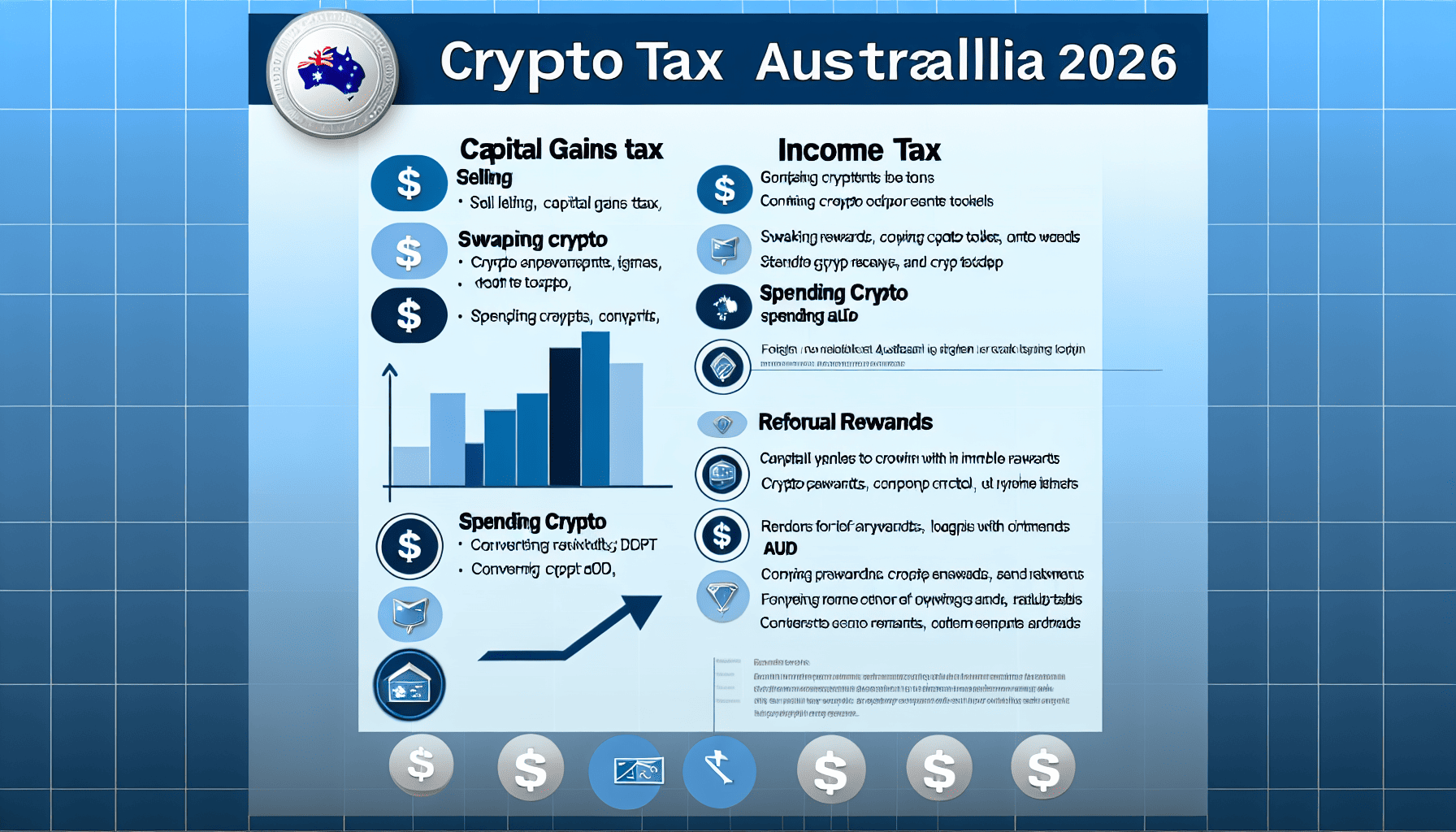
Some of the most confusing parts of Australia crypto tax 2026 involve events that do not fit neatly into a simple buy-and-sell pattern. Airdrops, chain splits and personal use claims all require careful classification.
Initial allocation airdrops
Airdrop tax Australia treatment depends on the type of airdrop. Initial allocation airdrops can receive special treatment at the time they are received. Investors should avoid two opposite mistakes: treating every airdrop as ordinary income by default, or treating every airdrop as tax-free by default.
The receipt treatment and the later disposal treatment are separate questions. Even where an initial allocation airdrop has special treatment at receipt, selling or swapping the tokens later can still create a CGT event.
Non-initial airdrops
Non-initial airdrops, promotional distributions, referral-based token distributions and reward-style token receipts may be more likely to be treated as income when received. The AUD value at receipt is usually the key figure for income reporting.
If those tokens are later sold, swapped or spent, the later transaction is generally reviewed under CGT rules. As with staking, the income value at receipt may become the starting cost base for the later disposal calculation.
Chain splits
Chain split crypto tax Australia treatment generally requires separate attention. Where a chain split creates a new asset, the new asset may have a $0 cost base. That matters when the new asset is later sold or swapped because the proceeds may be relevant to the capital gain calculation.
Investors should keep evidence showing when the split occurred, when they became able to access the new asset, the quantity received, and any later disposal. Chain split assets can be easy to miss if they are not visible in the exchange or wallet interface used for tax reporting.
When personal use asset treatment may apply
The personal use asset rules are often misunderstood. The exemption may apply only where crypto was acquired and used mainly for personal consumption or enjoyment, rather than for investment, trading or profit-making.
Factors that can weaken a personal use position include holding the crypto for a long period, using it as part of a portfolio, repeatedly trading it, or acquiring it because you expected it to rise in value. Investors should be cautious before relying on this treatment.
Investor vs Trader: Which Tax Rules Apply to You?
Crypto investor vs trader Australia is a common question because tax treatment can differ depending on whether you are investing or carrying on a business of trading.
Investor treatment
Most individual crypto holders are investors. In that case, disposals are usually dealt with under CGT rules, while staking rewards, DeFi rewards and other income-like receipts may be treated as ordinary income where applicable.
This is the treatment most people are dealing with when preparing a crypto tax return Australia. It applies to many long-term holders and casual investors, even if they make several transactions during the year.
Trader or business treatment
If your activity is frequent, organised, commercial in scale and conducted in a business-like way, you may be treated differently for tax purposes. In business scenarios, profits may be treated on revenue account rather than purely under CGT principles.
The analysis is highly fact-specific. There is no single trade-count test that automatically makes someone a trader. The overall pattern of activity matters more than one isolated factor.
Factors that may point toward business activity
- high frequency and regularity of transactions;
- systematic trading plans and documented processes;
- significant time commitment;
- commercial intent and scale;
- business-like record-keeping and operational behaviour;
- use of tools, systems or processes beyond casual investing.
Some people may have separate investor and business activities at the same time. For example, a person might hold long-term BTC as an investment while running a separate short-term trading activity. Classification should be reviewed carefully rather than guessed.
What Records Does the ATO Expect You To Keep?
Crypto record keeping Australia is where many otherwise compliant taxpayers run into trouble. The ATO expects records that allow transactions to be verified, AUD values to be reconstructed and tax treatment to be supported. Records should generally be kept for at least 5 years.
Good ATO crypto records should include:
- dates and times of transactions;
- the AUD value at the time of each transaction;
- receipts and invoices where relevant;
- wallet addresses and counterparties where available;
- exchange account statements and CSV exports;
- wallet records and access details;
- records of brokerage, gas, software, accountant and legal costs;
- DeFi export files, protocol records or block explorer evidence where relevant.
For simple exchange-only activity, exchange statements may provide much of the information needed. For DeFi users, exchange records alone are rarely enough. They may not capture wrapped tokens, bridge activity, LP positions, liquidity withdrawals, reward claims or smart contract interactions in a tax-ready format.
Strong records should answer three practical questions for every transaction:
- What asset left your control?
- What asset, right or value did you receive?
- What was the AUD value at that time?
If you cannot answer those questions months later, reporting becomes guesswork. The more chains, wallets and protocols you use, the more important it is to export and reconcile data regularly rather than waiting until tax time.
How to Report Crypto on Your Australian Tax Return
When preparing a crypto tax return Australia, the practical task is to separate capital transactions from income transactions and report each in the correct place.
What goes into capital gains and losses
Capital gains and capital losses generally come from disposals. This includes selling crypto for AUD, swapping one token for another, gifting crypto, spending crypto and many DeFi transactions where one asset or right is exchanged for another.
Capital losses may generally be used according to CGT rules, but they should be genuine and properly supported by records. Artificial arrangements designed primarily to create a tax loss can attract scrutiny.
What goes into income
Amounts treated as ordinary income may include staking rewards, some DeFi rewards, crypto received as payment, interest-style returns, referral rewards and certain token distributions. The amount is generally based on the AUD market value when received.
Income treatment at receipt does not remove the need to consider CGT later. If you later dispose of the same tokens, that later transaction may need to be reported separately.
Financial year dates
Australian individual tax returns generally follow the financial year from 1 July to 30 June. Your crypto activity needs to be reviewed within that period, including all exchange, wallet and DeFi activity that occurred during the year.
Filing deadline for individuals
For individuals lodging their own returns, the standard self-lodgment deadline generally applies. If you use a registered tax agent, you may have a later lodgment date, provided you are properly on their books in time.
Because administrative dates can vary depending on your circumstances, it is sensible to confirm the current crypto tax deadline Australia position when preparing your return.
Practical reporting workflow
- Export exchange, wallet and DeFi data for the full financial year.
- Classify each transaction as CGT, income or generally non-taxable.
- Calculate AUD values at the time of each relevant event.
- Build or verify cost bases, including relevant fees.
- Separate staking and DeFi reward income from later disposals.
- Net capital gains and losses according to the usual rules.
- Keep supporting records in case evidence is requested later.
If your crypto activity is simple, this workflow may be manageable with clean records. If you used multiple protocols, bridges and wallets, reconciliation can take much longer than expected.
Common Crypto Tax Mistakes Australian Investors Make
The biggest crypto tax mistakes are rarely dramatic. They are usually small classification errors repeated across many transactions.
Thinking wallet transfers are always 100% tax free
A transfer between wallets you own is generally non-taxable because there is no change in beneficial ownership. But a network fee paid in crypto can still create a disposal of the fee asset. Ignoring fees can leave gaps in your records.
Forgetting AUD valuation on swaps
A crypto-to-crypto swap still needs an AUD value at the time of the transaction. This applies to exchange trades and DeFi swaps. Treating token swaps as invisible because no fiat was involved is one of the most common crypto tax rules Australia mistakes.
Not separating income from later disposal
Staking rewards and DeFi rewards are often taxable when received. Later sale, swap or spend of those same tokens is a separate event. Combining both into one line item can produce the wrong result.
Missing DeFi token swaps and LP movements
Many investors track centralised exchange trades but ignore liquidity pool entries, LP token receipts, wrapping, lending positions and bridge-related asset changes. These are often the exact transactions that need the most careful review.
Poor record-keeping
Without timestamps, wallet histories, exchange exports and AUD values, accurate reconstruction becomes difficult. Waiting until tax season to rebuild a year of on-chain activity is a common and costly mistake.
Trying wash sales
Wash sale crypto Australia issues are important. Selling an asset to crystallise a loss and then repurchasing it in a way designed primarily to obtain a tax benefit can attract ATO scrutiny. Artificial loss-generation is not the same as legitimate portfolio rebalancing.
The ATO’s crypto data-matching activity also means investors should not assume crypto activity is invisible. Good records and consistent reporting are the safer approach.
FAQ: Crypto Tax Australia 2026
Is swapping crypto taxable in Australia?
Usually yes. Is swapping crypto taxable in Australia? In most cases, swapping one token for another is a disposal and can trigger CGT. You generally need the AUD market value of the transaction at the time of the swap.
Are staking rewards taxable?
Usually yes. Is staking taxable in Australia? Staking rewards are generally treated as ordinary income when received, based on fair market value in AUD. If you later sell, swap or spend those tokens, that later event can also trigger CGT.
Is moving crypto between wallets taxable?
Generally, moving crypto between wallets you own is not taxable because there is no change in beneficial ownership. However, fees paid in crypto may still have CGT consequences and should be recorded.
Do I pay tax if I only hold crypto?
Usually no. Simply holding crypto does not normally create a tax event. Tax generally arises when you dispose of crypto or when you receive taxable crypto income, such as staking rewards or certain DeFi rewards.
How long should I keep crypto tax records in Australia?
You should generally keep crypto tax records for at least 5 years. Records should include dates, AUD values, wallet addresses, exchange exports, receipts, fee records and DeFi evidence where relevant.
Are DeFi swaps taxable?
Usually yes. Exchanging one token for another through a DeFi protocol is generally treated as a disposal, similar to a swap on a centralised exchange. The transaction should usually be valued in AUD at the time it occurred.
Are airdrops taxable in Australia?
It depends on the type of airdrop. Some initial allocation airdrops may have special treatment at receipt, while other airdrops may be taxed as income. Later disposal of airdropped tokens can still trigger CGT.
Can I claim crypto losses?
Capital losses from crypto disposals can generally be used according to CGT rules to offset capital gains, subject to the usual tax rules. Losses should be genuine, well documented and not created through artificial wash sale behaviour.
Do I need to report crypto to the ATO?
If you disposed of crypto, received taxable crypto income, earned staking or DeFi rewards, or had other reportable crypto activity during the financial year, you generally need to include the relevant amounts in your Australian tax return.
Final Thoughts for Australian Crypto Investors
Australian crypto tax in 2026 is still built around one main distinction: disposals usually fall under CGT, while certain rewards, payments and earnings are taxed as income. For investors, the biggest risk areas are token swaps, staking rewards, DeFi positions, AUD valuations, network fees and incomplete records.
The safest approach is to classify every transaction by what actually happened: what asset left your control, what you received, and what the AUD value was at that time. For anyone active across staking, DeFi and multiple wallets, clean records are not just helpful. They are the foundation of a defensible crypto tax position in Australia.


