
MAS’s 2026 Consultation: Singapore Proposes Flexible Crypto Capital Framework for Banks
Why Singapore’s New Crypto Capital Rules Matter
Singapore has opened a significant new chapter in digital-asset regulation. On 17 April 2026, the Monetary Authority of Singapore published a consultation paper proposing a more risk-sensitive crypto capital framework for banks with exposures to cryptoassets on permissionless blockchains. Under the proposal, banks may classify qualifying assets as “Group 1” if they can demonstrate strong risk controls, potentially allowing lower capital charges than would otherwise apply.
The move is important because it departs from the more stringent Basel approach and from MAS’s earlier position, which would have treated many permissionless blockchain exposures more conservatively. The consultation remains open until 18 May 2026, while final prudential rules are not expected to take effect before January 2027. If adopted, the framework could influence how banks handle stablecoins, tokenised assets and on-chain financial products, while reinforcing Singapore’s ambition to remain a leading crypto-finance hub.
Quick Take: Key Points in One Glance
- MAS will let banks classify certain cryptoassets on public blockchains as Group 1 if they meet principle-based risk controls.
- Group-1 permissionless cryptoasset exposures would be capped at 2% of Tier-1 capital, with issuance and liability caps of 5%.
- Banks must notify MAS one month in advance and obtain senior-management sign-off.
- Immediate adoption is allowed under the interim approach; final rules are not expected before 2027.
Basel’s Framework vs MAS’s Earlier Stance
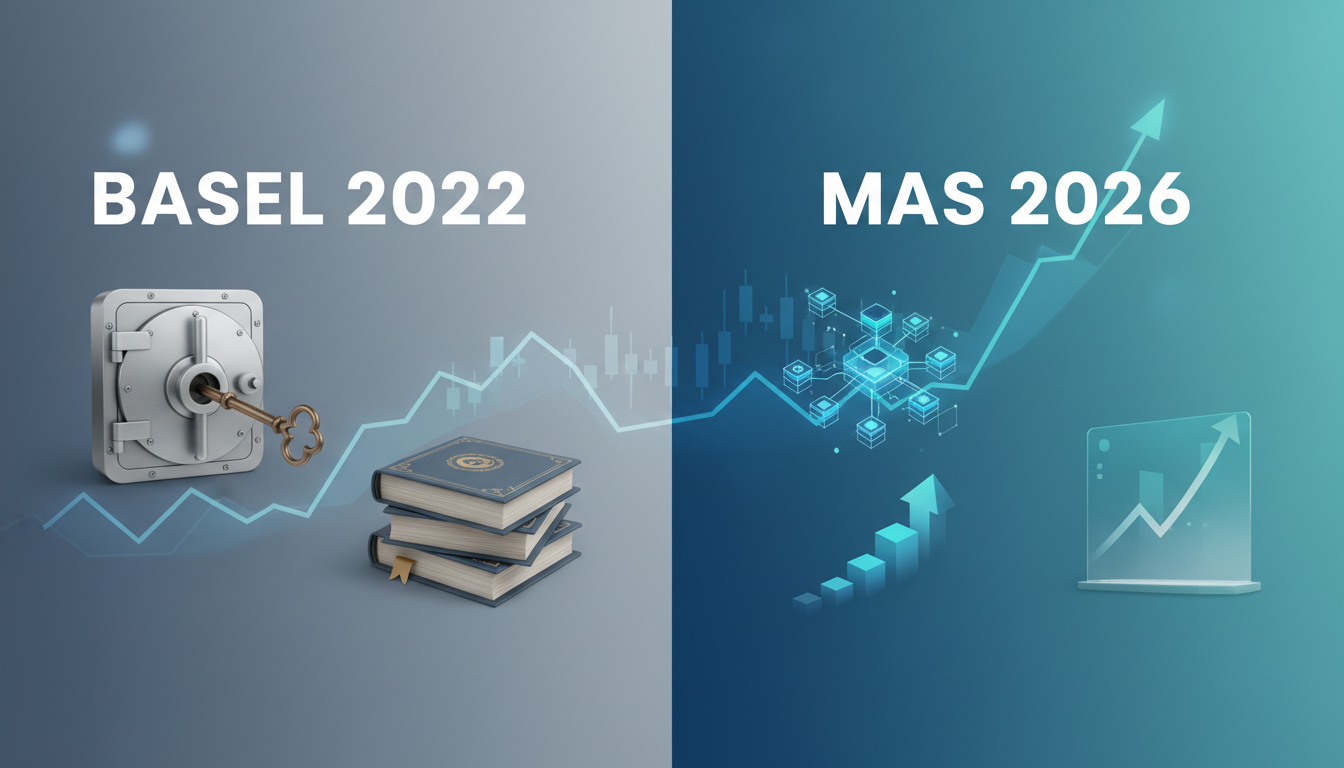
The Basel Committee’s 2022 cryptoasset standards divided bank exposures into two broad categories. Group 1 included tokenised traditional assets and certain well-regulated stablecoins. Group 2 covered other cryptoassets, including assets issued on permissionless blockchains, and attracted highly conservative treatment. In many cases, Group 2 assets faced a 1,250% risk weight, making them expensive for banks to hold.
MAS initially appeared ready to align Singapore with that global standard. In March 2025, it consulted on a framework that would have implemented the Basel-style approach from January 2026. Industry feedback challenged the treatment as not technology-neutral and overly punitive, especially where banks could apply robust controls to permissionless networks.
MAS later deferred implementation to 1 January 2027 and said it would re-examine the issue. The April 2026 consultation is the result of that reassessment, offering a more granular path for banks without removing supervisory discipline.

Inside the April 2026 Consultation
The core of MAS’s proposal is a principle-based pathway for selected permissionless cryptoassets to qualify as Group 1. Banks would need to show that the relevant risks are adequately mitigated through governance, operational controls, on-chain analytics, legal certainty and clear settlement finality. The framework does not assume that every public blockchain asset is suitable; it asks whether a bank can manage the risks in practice.
The flexibility comes with clear limits. Group-1 permissionless cryptoasset exposures would be capped at 2% of a bank’s Tier-1 capital. Liabilities and issuances linked to those assets would be capped at 5%. Any exposure beyond the stated limits would revert to more conservative capital treatment.
Banks would also face process requirements before using the treatment. MAS expects one month’s prior notification, senior-management confirmation that the classification is appropriate, and, in some cases, explicit MAS approval. Banks may begin using the interim framework immediately, rather than waiting for the final rulebook. The consultation closes on 18 May 2026.
| Area | MAS 2026 Proposal | Practical Effect |
|---|---|---|
| Eligibility | Permissionless cryptoassets may qualify as Group 1 if risk controls are sufficient | Creates a route for selected public-blockchain assets to avoid blanket punitive treatment |
| Exposure cap | 2% of Tier-1 capital | Allows limited participation while containing balance-sheet risk |
| Issuance and liability cap | 5% of Tier-1 capital | Supports controlled issuance and product structuring |
| Governance | MAS notification and senior-management sign-off required | Raises accountability inside regulated banks |
| Timing | Immediate interim use; final rules not before January 2027 | Gives banks time to prepare before the final prudential regime |
Risk Controls: AML/CFT and Traceability
MAS is not relaxing its expectations on financial-crime controls. Anti-money-laundering and counter-terrorism financing safeguards remain a non-negotiable condition for more favourable treatment. Banks must be able to identify transaction participants where necessary, trace fund flows and manage financial-crime risk effectively.
That requirement will influence which networks can realistically qualify. Public blockchains with mature on-chain analytics and compliance tooling, such as Ethereum, may be easier for banks to assess. Privacy-centric networks may face greater barriers because traceability and participant identification are harder to demonstrate. MAS is also seeking feedback on whether its AML/CFT requirements are calibrated appropriately.
Why MAS Is Moving Ahead of Basel
MAS’s proposal reflects a strategic choice. In 2025, the Basel Committee acknowledged that its provisions for permissionless blockchains needed further review, but it did not provide a firm timeline for revised standards. Waiting indefinitely could leave Singapore at a disadvantage if institutional tokenisation, stablecoin settlement and blockchain-based capital markets continue to develop elsewhere.
Singapore has repeatedly signalled that it wants credible digital-asset activity to occur inside a regulated environment. Its stablecoin framework, finalised in 2025, and institutional pilots such as Project Guardian show a preference for early, supervised experimentation rather than regulatory paralysis.
The proposed crypto capital framework is therefore not deregulation. It is a move toward assessing risk by substance, governance and controls instead of treating permissionless technology as automatically disqualifying. That contrasts with more conservative approaches in markets such as Canada and parts of the EU, where permissionless cryptoasset exposures remain difficult for banks to support at scale.
Impact on Banks, Stablecoins and Tokenised Assets
If MAS finalises the proposal broadly as drafted, Singapore banks could gain a more workable route to holding and transacting in selected stablecoins and tokenised assets without prohibitive capital charges. Major stablecoins such as USDC and USDT may attract closer institutional review if banks believe they can satisfy Group 1 criteria and the related risk-control expectations.
The 2% and 5% caps are cautious, but they are not meaningless. For banks with substantial Tier-1 capital, the limits could still support treasury use cases, settlement pilots, tokenised collateral arrangements, digital securities workflows and other institutional products. The caps also help MAS keep exposures bounded while banks build operational experience.
Stablecoin issuers may benefit if regulated banks become more willing to hold, settle or integrate eligible tokens. Demand could grow for bank-linked stablecoin products, custody arrangements and payment infrastructure, provided the assets meet prudential and compliance requirements. Banks would still need strong governance, clear accountability and risk oversight before treating any asset favourably.
The tokenisation market could also gain momentum. Projects linked to institutional tokenised finance, including Project Guardian, may become more commercially viable if banks can apply a practical Group-1 pathway to assets used in settlement, issuance or collateral management. A more flexible crypto capital framework could therefore support the next phase of wholesale digital finance in Singapore.
MAS is still maintaining strict protections for retail investors. Digital securities that count toward regulatory capital can only be issued to accredited or institutional investors. That preserves a clear divide between wholesale innovation and mass-market distribution, even as banks receive more room to develop blockchain-based financial services.
International Context and Comparisons
Singapore’s approach stands out because the Basel Committee has not yet released revised rules for permissionless blockchain exposures. Major markets including the US, EU and UK continue to treat these assets conservatively, particularly where banks are concerned. MAS is taking a more tailored route while still leaving room for later alignment with global standards.
Across Asia, regulatory models vary. Hong Kong has focused on licensing regulated digital-asset activity, while Japan has developed clearer stablecoin rules. Singapore’s proposal is different because it focuses on prudential treatment inside the banking system. That could strengthen the country’s competitive position, provided MAS continues balancing innovation with financial stability and international interoperability.
Next Steps and Consultation Timeline
The consultation runs until 18 May 2026. MAS is inviting feedback from banks, crypto service providers and the public on how the interim approach should work and whether the safeguards are appropriately designed.
The final prudential framework will not take effect before 1 January 2027, giving banks time to review eligible assets, upgrade monitoring systems, prepare governance processes and assess capital impacts. Stakeholders with direct exposure to stablecoins, custody, tokenisation or bank balance-sheet treatment should follow MAS updates closely and consider submitting feedback before the deadline.
What This Means for Investors and Users
For most retail investors, the immediate impact will be limited. The consultation primarily affects banks and institutional players, not everyday trading access. Over time, however, consumers may see safer and more regulated products emerge from bank-led tokenised finance, such as stablecoin-linked payment services or tokenised bond access through institutional channels.
That does not make digital assets low-risk. MAS has repeatedly warned that crypto is not suitable for the general public in many cases, and platforms serving Singapore users must operate within the applicable regulatory framework. Retail users should avoid assuming that a bank-focused capital rule makes speculative crypto trading safer.
Anyone buying, storing or transferring digital assets should use regulated platforms where available, understand custody risks and secure their wallets properly. CoinixPro readers can learn the basics of hot and cold storage in the guide to best crypto wallets for beginners in Singapore, and review safer platform considerations through the compare crypto exchanges category.
Singapore’s Next Frontier in Crypto Regulation
MAS’s consultation marks a major step toward a practical, risk-sensitive crypto banking regime. By allowing selected permissionless blockchain assets to qualify for lower capital treatment under strict safeguards, Singapore is trying to stay competitive without weakening financial-system protections. The final rules, expected no sooner than 2027, could shape the future of stablecoins, tokenised assets and institutional crypto finance in Singapore.
Readers following MAS’s proposals can stay informed through CoinixPro’s news and guides, and should watch closely as banks, stablecoin issuers and tokenisation platforms respond to the consultation.


