
## Introduction: Kraken’s banking ambitions
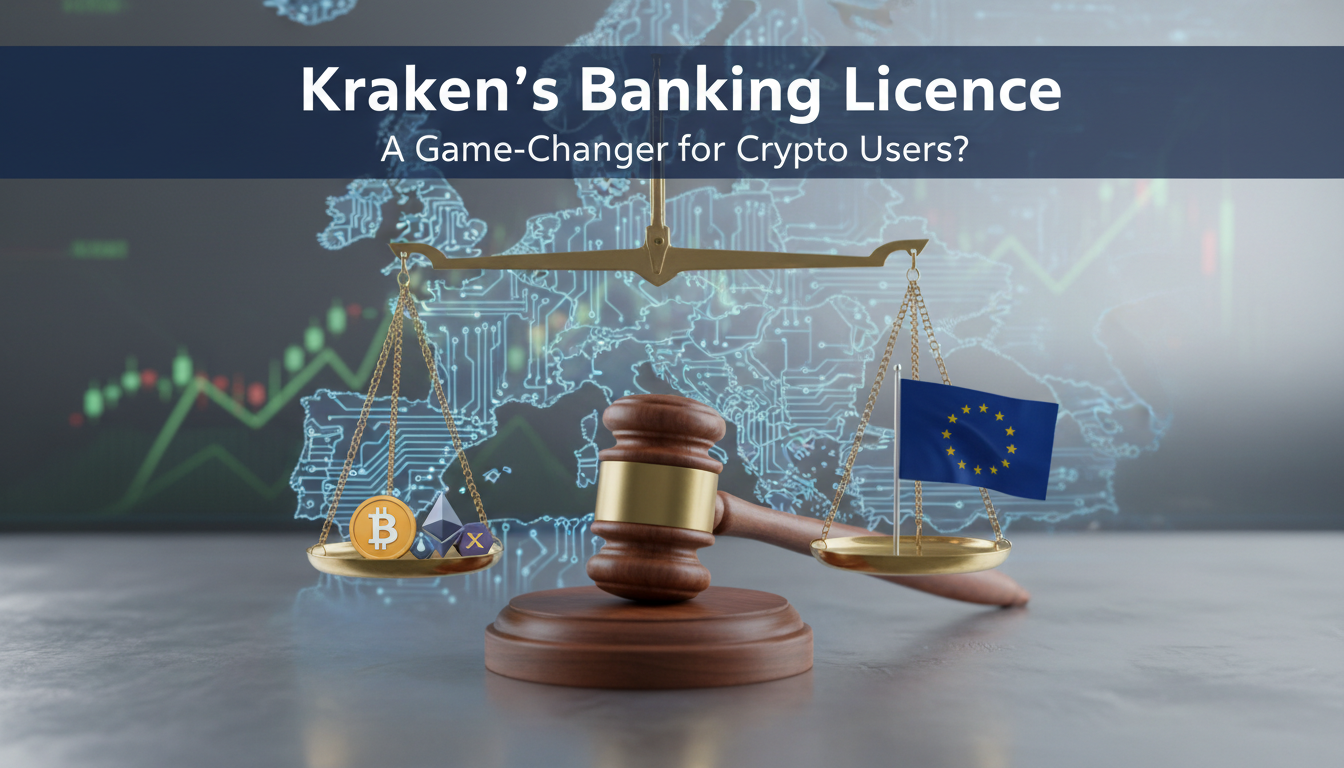
Kraken has reportedly applied for a full European banking licence, with Lithuania named in media coverage as the likely jurisdiction. The July 2026 news, reported by Decrypt, follows Revolut’s move to expand its own regulated banking footprint in Europe. For a major crypto exchange, the step is significant: a Kraken banking license could move the platform closer to traditional financial services, with potential implications for deposits, payments and future products available to UK investors.
## What is a full banking licence?
A full banking licence is a regulatory permission that can allow a firm to accept customer deposits, provide payment services and, depending on the licence scope, offer products such as payment accounts, debit cards or lending. It usually brings stricter oversight than lighter permissions because deposit-taking is treated as a core banking activity.
This differs from an e-money licence, which many crypto and fintech firms use to handle customer funds for payments. E-money licensing can support wallets, transfers and card-linked payment services, but it does not usually give the same status as a banking licence definition would imply. Crucially, a banking licence may bring deposit insurance protections where eligible, while e-money balances are typically safeguarded under different rules rather than covered as bank deposits.
For crypto firms dealing in Bitcoin, Ethereum and stablecoins such as USDT and USDC, that distinction matters. A banking licence could help bridge blockchain-based services with regulated payments infrastructure, but it also raises the compliance bar.
### Details of Kraken’s application
According to the Decrypt report referenced in the brief, Kraken’s application is understood to be in Lithuania, with the aim of obtaining an EU-wide licence. The process would involve the Bank of Lithuania and the European Central Bank, as is typical for banking authorisation in the European Union. Kraken is reported to be seeking a position as the only crypto exchange with a full banking licence, a move that invites comparison with Revolut Bank and Revolut’s European banking licence. Approval is not automatic, and the timeline depends on regulators.

## Why this matters for UK customers
For UK investors, the immediate question is whether an EU licence would translate into new services in Britain. Before Brexit, passporting rules allowed many financial firms authorised in one European Union member state to serve customers across the bloc. The UK’s departure changed that framework, so an EU licence does not automatically mean the same permissions apply to UK residents.
Even so, a Kraken banking license could still shape the platform’s long-term product roadmap. If local rules allow, regulated banking permissions might support features such as payment accounts, debit cards or interest-bearing products. Those services would depend on the exact licence, Kraken’s operating structure and UK requirements.
The Financial Conduct Authority remains the key regulator for crypto activity aimed at UK consumers. Any expansion would need to sit alongside FCA regulations, including rules on promotions, registration and consumer protection. Revolut offers a useful comparison because it operates across both fintech and banking, but its permissions and customer protections vary by jurisdiction.
## Context: crypto regulation in Europe and the UK
Europe has been building a more formal rulebook for digital assets and payments. MiCAR, the Markets in Crypto-Assets Regulation, sets a framework for crypto-asset service providers and stablecoin issuers, with implementation deadlines running through 2024 and 2025. PSD2, meanwhile, underpins much of Europe’s modern payments environment. Readers comparing MiCAR and PSD2 should understand that they address different parts of the financial system: crypto services on one side, payment services on the other.
The UK has taken a separate post-Brexit path. The FCA has tightened its approach to crypto promotions and continues to develop its framework for firms serving UK consumers. That makes cross-border service design more complex for companies such as Kraken, Binance, Coinbase and Circle.
A banking licence would not make crypto products risk-free. Instead, it would likely subject Kraken to additional scrutiny, including capital requirements, governance standards and anti-money-laundering controls. Traditional banks operating in Lithuania and the UK already work within these expectations; a crypto-native firm moving into banking would be judged against comparable standards.
## Potential market impact
If approved, the Kraken banking license could be read as another sign that crypto and fintech are converging with mainstream finance. Banking authorisation may increase trust among some customers because it places a firm inside a more familiar regulatory perimeter. It could also help Kraken compete more directly with neobanks, payment apps and traditional banking providers.
The wider market will be watching closely. A successful application may encourage other exchanges, including Binance and Coinbase, to consider whether deeper banking permissions are strategically useful. It could also influence how investors view regulated crypto infrastructure, especially where stablecoins, payment accounts and fiat deposits increasingly overlap.
Revolut’s presence is important because it shows how a consumer finance brand can blend app-based banking, payments and crypto access. Kraken’s route may be different, but the market signal is similar: crypto platforms are no longer focused only on trading interfaces. They are exploring account functionality, deposits, payments and broader financial tools.
## Risks and limitations
There are several caveats. Regulatory approval is not guaranteed, and banking licences require robust AML systems, capital resources and ongoing supervision. Even if Kraken receives authorisation, the first services may be limited to European Union residents rather than UK customers.
Retail restrictions are another consideration. Regulators may limit how high-risk crypto products are marketed or combined with banking-style services. Deposit insurance, if available, would usually apply only to eligible bank deposits, not to cryptoassets such as Bitcoin, Ethereum or stablecoins. Post-Brexit divergence also means UK access cannot be assumed until Kraken or relevant regulators confirm the details.
## Conclusion
Kraken’s reported banking application marks a notable step in the convergence of crypto exchanges, neobanks and traditional finance. A full banking licence could support new services and stronger regulatory oversight, but it also brings demanding compliance obligations.
UK readers should follow official updates from Kraken, the Bank of Lithuania, the European Central Bank and the FCA before drawing conclusions. This article is for informational purposes only and does not constitute financial advice. Crypto markets are volatile, and any decision should fit your own circumstances and risk tolerance.
## FAQ
### What is the difference between a banking licence and an e-money licence?
A banking licence can allow a firm to take deposits, provide payment services and potentially lend. An e-money licence usually permits handling customer funds for payments, but it is not the same as deposit-taking and may not provide the same deposit insurance protections.
### When could Kraken receive its banking licence?
There is no confirmed approval date. The licence timeline depends on the Bank of Lithuania, the European Central Bank and whether Kraken meets capital, governance and compliance requirements. The process may take months and approval is not guaranteed.
### Will UK users get deposit insurance?
Not automatically. EU deposit insurance applies to eligible deposits at authorised EU banks, while UK protection depends on local rules such as FSCS eligibility. UK investors should wait for official announcements before assuming any coverage.
### Are there other crypto exchanges with banking licences?
Few crypto-focused exchanges hold full banking licences. Revolut has a European banking licence through Revolut Bank, although it is primarily known as a fintech and banking app rather than a standalone crypto exchange.
### How can I prepare for new services?
Follow official Kraken updates and regulator guidance rather than relying on rumours. Review how any new account, payment or deposit product is regulated, understand crypto risks and avoid treating banking permissions as a guarantee of investment safety.


