
Wall Street’s Shift to Tokenization: Why Singapore Should Pay Attention
Wall Street tokenization is moving from a crypto-adjacent experiment into a mainstream financial market theme. According to Financial Times reporting, major institutions are exploring how blockchain can support tokenized assets, automated settlement and programmable finance. For Singapore, this is not a distant United States story. It connects directly with MAS tokenization work, Project Guardian, digital assets Singapore policy, and the infrastructure used by banks, fintech companies and institutional investors.
Wall Street Is Moving Toward Tokenized Finance
Wall Street tokenization reflects a broader shift in how traditional finance views blockchain. Rather than focusing only on speculative crypto trading, institutions are examining how Distributed Ledger Technology (DLT) can make existing markets more efficient. The Financial Times has reported that firms across institutional finance are looking at tokenized securities, tokenized funds and blockchain-based settlement as practical market infrastructure.
The appeal is clear: tokenized assets can, in principle, trade around the clock, settle faster and carry rules inside smart contracts. That could reduce manual processing, improve transparency and lower settlement costs across parts of the financial system. Blockchain finance also allows assets to become programmable, meaning functions such as transfers, compliance checks or distributions may be automated under defined conditions.
Names associated with institutional blockchain adoption include BlackRock, Nasdaq, NYSE, JPMorgan and DTCC. Some initiatives involve Ethereum tokenization or Ethereum-compatible infrastructure, while others use permissioned blockchain systems designed for regulated finance. The common theme is not replacing financial markets overnight, but testing whether digital securities and real-world assets (RWA) can operate more efficiently on blockchain rails.
This is why Wall Street tokenization matters beyond crypto markets. It signals that major financial institutions now see tokenization as a long-term infrastructure question, not only a digital asset trading trend.

Why This Matters for Singapore
Singapore has been preparing for this shift for years. The Monetary Authority of Singapore (MAS) launched Project Guardian in May 2022 to explore tokenization, institutional DeFi-style infrastructure and digital asset networks under controlled conditions. MAS tokenization work has helped position Singapore as one of the key jurisdictions studying how blockchain can fit into regulated financial markets.
That makes Wall Street tokenization highly relevant for Singapore. If institutions in the United States, United Kingdom, Hong Kong and other financial centres accelerate tokenized finance, Singapore’s existing policy work and fintech ecosystem could become more strategically important. The country already has active banks, payment firms, custodians and blockchain companies working around digital assets Singapore infrastructure.
Banks such as DBS and Standard Chartered are part of the broader regional conversation around tokenized assets Singapore development. Local reporting from Fintech News Singapore has also highlighted Singapore’s role in blockchain finance and institutional digital asset experimentation. For readers following Singapore crypto regulation, the key point is that MAS has generally focused on responsible innovation, risk controls and financial stability rather than unregulated speculation.
What Is Asset Tokenization?
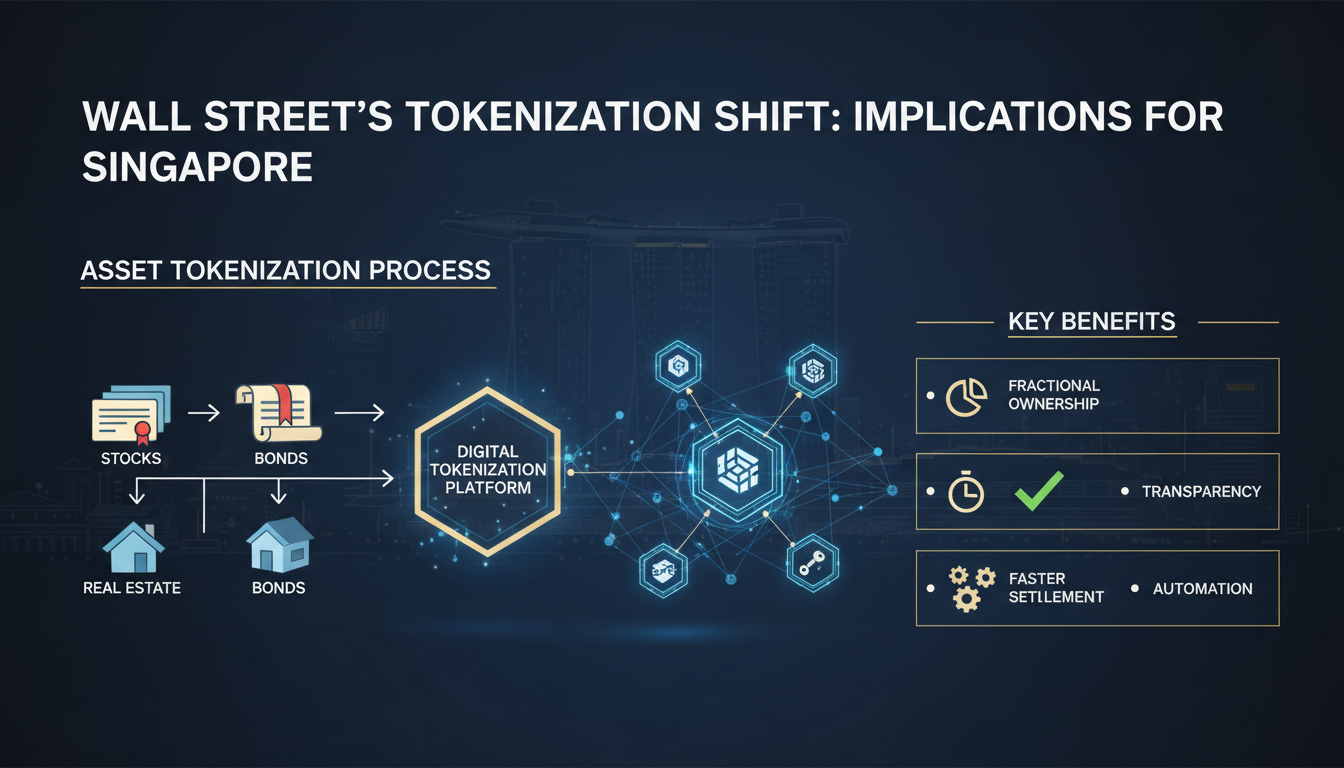
Asset tokenization means representing ownership or rights to a real-world or financial asset as a digital token on a blockchain. These may include stocks, bonds, money market funds, real estate, deposits or other financial instruments. In market discussions, these are often called real-world assets, or RWA, when traditional assets are issued or recorded using blockchain technology.
A token does not automatically make an asset valuable or safe. The important question is what the token legally represents, who issues it, how custody works, what regulations apply and whether the blockchain record is connected to enforceable ownership rights. That distinction matters for institutional investors, regulators and retail users trying to understand digital assets.
The attraction is operational. Asset tokenization may allow fractional ownership, faster settlement, improved auditability and automation through smart contracts. In some models, investors could hold tokenized securities or tokenized deposits with clearer on-chain records. In others, tokenization may support back-office efficiency rather than direct retail access.
Ethereum is often discussed because many tokenization projects use Ethereum or Ethereum-compatible smart contracts. Yet institutional blockchain systems may also be permissioned, meaning access is limited to approved participants. Readers who want broader educational context can explore our blockchain trading guides.
Examples of Tokenized Assets
Examples include tokenized stocks, bonds, money market funds, real estate interests, tokenized deposits and fund units. Franklin Templeton is one of the traditional asset managers associated with tokenized fund activity, while stablecoins are often discussed alongside tokenized cash settlement.
Why Institutions Prefer Tokenization
Institutions are interested because tokenization could reduce reconciliation work, improve settlement efficiency and support programmable compliance. Smart contracts may automate processes that currently require multiple intermediaries, though legal, custody and technology risks still need careful management.
Potential Impact on Investors and Crypto Companies
For investors, Wall Street tokenization could gradually change the range of products available in digital markets. More tokenized securities, tokenized funds and blockchain-based settlement tools may appear as institutional investors become more comfortable with digital finance. This does not mean immediate access for every retail user, but it could reshape how investment products are created and distributed.
Crypto companies may also feel the impact. Exchanges such as Coinbase, Kraken and platforms connected to digital asset trading could see more demand for compliant custody, institutional-grade wallets, reporting tools and market access. Fintech companies may find opportunities in settlement, identity, analytics and infrastructure rather than purely speculative token listings.
Ethereum remains central to many conversations because smart contracts are widely used for tokenization experiments. If tokenized asset activity grows, the Ethereum ecosystem could benefit from greater developer interest and institutional testing. Still, not every project will use public Ethereum, and regulated institutions may prefer private or hybrid blockchain systems.
Robinhood and other retail-facing platforms may also monitor how tokenized securities develop, especially if regulators create clearer rules. The bigger signal is that blockchain finance is becoming part of capital markets strategy. Bitcoin, stablecoins and tokenized deposits may all sit within a wider digital asset market, but they serve different functions and carry different risks.
Risks and Challenges
Tokenization does not remove financial risk. It changes how assets are issued, recorded, transferred and settled. Regulators such as MAS, the SEC, the ECB and international bodies including the IMF and Bank for International Settlements (BIS) continue to examine how tokenized markets affect investor protection, liquidity, custody and financial stability.
Several challenges remain unresolved. Different blockchains may not interoperate smoothly. Smart contracts can contain vulnerabilities. Cybersecurity failures could affect wallets, custodians or infrastructure providers. Liquidity may be thin if tokenized assets trade on fragmented venues. Legal questions may arise if the token record and traditional ownership record do not align.
For Singapore, the policy challenge is balancing innovation with market integrity. MAS tokenization projects show that experimentation can happen within structured frameworks, but broad adoption will depend on regulation, operational resilience and investor safeguards.
Conclusion
Wall Street tokenization is becoming a serious long-term theme in institutional finance. For Singapore, the trend connects directly with Project Guardian, MAS tokenization policy, DBS, Standard Chartered and the country’s wider fintech ecosystem. Investors should watch developments closely, but they should not assume that tokenized assets will produce quick returns or eliminate market risk.
Digital assets and tokenized financial products involve risks, and regulations vary by jurisdiction. This article is for informational purposes only and is not financial or investment advice. To keep tracking institutional blockchain adoption, follow the latest crypto news.
FAQ
What is asset tokenization?
Asset tokenization is the process of representing ownership rights or economic exposure to an asset as a blockchain-based token. The asset may be a bond, fund unit, stock, real estate interest, deposit or other financial instrument, depending on the issuer and legal structure.
Why is Wall Street interested in blockchain?
Wall Street is interested in blockchain because tokenization may support faster settlement, 24/7 market access, programmable assets and lower operational costs. Institutions are focusing less on crypto speculation and more on regulated market infrastructure.
How is Singapore involved in tokenization?
Singapore is involved through MAS initiatives such as Project Guardian, launched in May 2022, and through its fintech ecosystem. Banks including DBS and Standard Chartered are part of the broader regional conversation around tokenized assets Singapore development.
Does tokenization replace cryptocurrencies?
Tokenization does not replace cryptocurrencies. Bitcoin, Ethereum, stablecoins, tokenized deposits and tokenized securities serve different purposes. Tokenization uses blockchain infrastructure to represent assets, while cryptocurrencies may function as networks, payment assets or settlement tools.
Can retail investors benefit from tokenized assets?
Retail investors may eventually gain access to more efficient or fractional products, but availability depends on regulation, issuer structure, platform access and investor protections. Tokenized assets still carry market, liquidity, custody, technology and legal risks.
Sources referenced: Financial Times reporting on institutional tokenization; Monetary Authority of Singapore Project Guardian documentation; Fintech News Singapore coverage of Singapore’s tokenization and blockchain finance ecosystem.


