
Singapore crypto scam tracing is becoming a more formal part of the country’s cybercrime response. In a 9 July 2026 Police Life update, the Singapore Police Force described how the Anti-Scam Centre’s Crypto Tracing Team works with bank employees, traces scam proceeds, freezes scam-linked accounts and uses artificial intelligence and machine learning to disrupt scam websites. The update followed the operationalisation of the Cyber Command on 3 July 2026, bringing anti-scam, cybercrime and digital disruption capabilities under a more coordinated structure.
Source: Singapore Police Force, “Inside Singapore’s Scam War: PM Lawrence Wong Visits the SPF’s Cyber Command,” updated 9 July 2026.
Singapore Police Expands Its Crypto Scam Response
The Singapore Police Force operationalised the Cyber Command on 3 July 2026 to strengthen the national response to scams and cybercrime. The 9 July Police Life publication then gave a closer look at how the structure works in practice, including Singapore Police crypto tracing, bank coordination and online disruption.
Source: Singapore Police Force, Cyber Command launch release, 3 July 2026.
What the Cyber Command Brings Together
The SPF Cyber Command combines several capabilities: the Cyber Operations Centre, Anti-Scam Centre, Crypto Tracing Team, Cyber Specialist Team, Online Disruption Team, cybercrime investigators and public education functions. Its work spans prevention, detection, disruption, investigation and cooperation with foreign law enforcement agencies, including partners in overseas jurisdictions across Southeast Asia and beyond. It is not a crypto regulator; its role is law enforcement and cybercrime response.
The Role of the Crypto Tracing Team
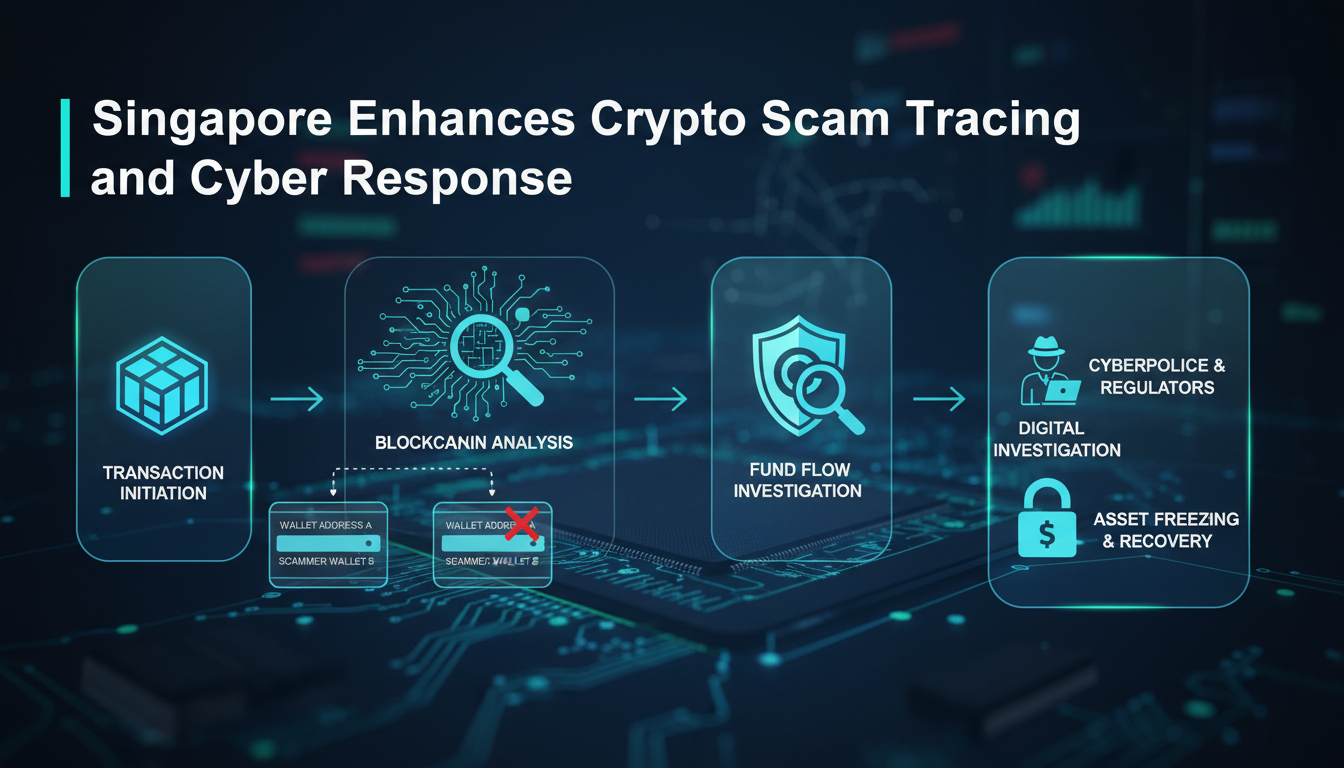
The Crypto Tracing Team Singapore capability focuses on identifying how scam proceeds move through cryptocurrency wallets and services. Investigators may examine wallet addresses, transaction hashes and on-chain transaction flows to identify related wallets, exchanges used to receive or convert funds, and possible intervention points. Blockchain intelligence can support an investigation, but it does not automatically identify the person controlling a wallet or guarantee asset recovery.
Source: Singapore Police Force, Police Life Cyber Command article, updated 9 July 2026.
Why the Development Matters in Singapore
Singapore has a highly digital banking and payments environment, which makes speed essential when scammers persuade victims to transfer money or digital assets. Cryptocurrency scams Singapore 2026 may involve investment scam pitches, government impersonation scam tactics, job scam offers, phishing links or requests to send Bitcoin, Ethereum, Tether, USDT and other stablecoins to a crypto wallet. These examples should not be read as assets named in the Cyber Command announcement; they are commonly transferred digital assets used across the wider market.
The initiative forms part of a wider regional response to digital asset crime covered in our latest cryptocurrency news. ScamShield guidance identifies government impersonation scams, investment scams and job scams as major cryptocurrency-related scam models, and warns that cryptocurrency transfers are generally non-reversible. That is why rapid reporting, transaction monitoring and cooperation between investigators, banks and cryptocurrency exchanges can matter as much as the tracing itself.
Source: ScamShield cryptocurrency-related scams guidance.
How Cryptocurrency Scam Tracing Works
Blockchain tracing is the process of following public blockchain records between wallet addresses. A public ledger can show where assets moved, but it does not by itself reveal the real-world identity behind every crypto wallet.
Following Funds Across the Blockchain
A typical tracing process starts when investigators obtain the victim’s transaction details, including the transaction hash and destination wallet. They can then follow later transfers through a blockchain explorer or specialist wallet analysis tools. Related addresses and transaction patterns may be reviewed through on-chain analysis and wallet clustering. The aim is to find whether a scam wallet sends funds to an identifiable service, such as a regulated exchange. This is analysis, not automatic recovery.
Why Exchanges and Banks Are Important
Intervention becomes more practical when funds reach a cryptocurrency exchange, payment service or bank account that may hold KYC information. In a June 2026 anti-cryptocurrency scam operation, announced by SPF on 5 July 2026, Coinbase, Coinhako, Gemini, Independent Reserve, OKX, StraitsX and Upbit worked with police. SPF said blockchain analysis supported by Chainalysis and TRM Labs helped identify more than 130 potential victims and prevent over S$2.9 million in potential losses. These exchanges were partners in the anti-scam operation, not accused parties. Readers who want to reduce wallet risk can review our crypto trading and wallet security guides.
Source: Singapore Police Force, joint operation with cryptocurrency exchanges, 5 July 2026.

Banks, Exchanges and AI in Singapore’s Anti-Scam System
Singapore Cyber Command crypto work sits within a broader public-private partnership. Police lead investigations, cryptocurrency tracing, intervention and cross-border investigation. Banks help detect suspicious transfers, warn customers and freeze scam-tainted accounts where legally possible. Cryptocurrency exchanges may provide timely account information and support investigations under applicable procedures. Blockchain analytics providers such as Chainalysis and TRM Labs help map transactions and identify connections between addresses.
The 9 July SPF material says bank staff are co-located at the Anti-Scam Centre and that police work with banks to freeze scam-linked bank accounts and trace proceeds. It also says artificial intelligence and machine learning are used in digital disruption efforts against scam websites and related online infrastructure. A separate SPF operation announced on 7 July 2026 involved DBS, UOB, OCBC, Standard Chartered Bank and GXS using Robotic Process Automation to identify potential victims and send warnings. For broader policy context, see our guide to Singapore crypto regulation.
Sources: Singapore Police Force, Police Life Cyber Command article, updated 9 July 2026; Singapore Police Force, five-bank operation announcement, 7 July 2026.
What the Initiative Means for Crypto Users and Companies
For retail cryptocurrency users, the main benefit may be earlier warnings when suspicious activity is detected by banks, exchanges or investigators. That does not make digital asset transfers risk-free. Prevention remains more reliable than recovery, especially because an irreversible cryptocurrency transfer can leave Singapore quickly through overseas wallet services or multiple blockchain networks.
For exchanges, the development points to stronger expectations around transaction monitoring, customer identification, rapid response procedures and cooperation with authorities. For banks and payment providers, real-time information exchange, suspicious transaction detection and customer outreach are likely to remain central to scam interdiction.
For legitimate crypto companies Singapore users interact with, stronger enforcement may improve trust in compliant digital asset services. It may also increase operational and compliance demands, particularly around KYC, suspicious transaction reporting and customer protection. Users comparing services should focus on transparency, account controls, withdrawal checks and support processes; our separate guide explains how to assess cryptocurrency platforms without treating any platform as guaranteed protection.
Limits of Crypto Tracing and Fund Recovery
Crypto scam recovery has practical and legal limits. A visible blockchain transaction does not always identify the person controlling the wallet. Scammers may move stolen cryptocurrency through numerous wallets, overseas services, money mule networks or several blockchain networks. Funds may be converted, withdrawn or transferred before police, banks or exchanges can intervene. Some services may operate in jurisdictions where cooperation is slow or limited.
ScamShield advises victims to act quickly because recovery becomes harder once funds move overseas. Tracing may support asset recovery or interdiction in some cases, especially when funds reach a cooperating exchange or financial institution, but it does not guarantee that assets can be frozen, recovered or returned.
Source: ScamShield guidance for people who have been scammed.
Cryptocurrency transactions may be irreversible, and tracing stolen digital assets does not guarantee that funds can be frozen, recovered or returned. This article is provided for general informational purposes and does not constitute financial, legal or investment advice.
What to Do After a Crypto Scam in Singapore
Anyone trying to understand how to report a crypto scam in Singapore should act quickly and preserve evidence. Stop communicating with the suspected scammer and do not send more money for “recovery”, “tax”, “verification” or withdrawal fees. Contact the affected bank or cryptocurrency exchange immediately. Save transaction hashes, wallet addresses, chat records, screenshots, profile links and payment confirmations.
Secure email, exchange and social media accounts, especially if a seed phrase, private key, password or one-time code may have been exposed. File an official police report and provide the available transaction details. ScamShield can be used to check or report suspicious messages, calls and links, but a ScamShield submission does not replace an official police report when money has been lost. ScamShield also provides a 24/7 helpline at 1799 for people who are unsure whether something is a scam.
Sources: ScamShield cryptocurrency-related scams guidance; ScamShield guidance for people who have been scammed.
What Happens Next for Singapore’s Crypto Scam Response?
The Cyber Command represents a more coordinated Singapore crypto scam response, combining police investigations, blockchain analysis Singapore Police capabilities, bank cooperation, exchange data, online disruption and public education. Its practical effectiveness will depend on early reporting, fast information sharing and cross-border cooperation with overseas authorities. For users, crypto security, account hygiene and scepticism toward unsolicited offers remain the first line of defence.
What Is the Singapore Cyber Command?
The Singapore Cyber Command is a Singapore Police Force command operationalised on 3 July 2026 to coordinate scam and cybercrime prevention, investigation, disruption, intelligence, partnerships and public education. It is not a cryptocurrency-only organisation.
What Does the Crypto Tracing Team Do?
The Crypto Tracing Team analyses cryptocurrency transaction flows connected to reported scams and works with investigators, financial institutions and digital asset services. Tracing a transaction may support an investigation, but it does not guarantee identification or recovery.
Can Singapore Police Recover Stolen Cryptocurrency?
Recovery may be possible when funds are identified and intercepted quickly, particularly if they reach a cooperating exchange or financial institution. It is not guaranteed, especially after assets move overseas or through multiple services.
Which Crypto Exchanges Have Worked with Singapore Police?
The June 2026 operation announced by SPF on 5 July involved Coinbase, Coinhako, Gemini, Independent Reserve, OKX, StraitsX and Upbit. They participated as anti-scam partners and should not be described as suspects or scam platforms.
How Can I Report a Cryptocurrency Scam in Singapore?
Contact the affected bank or exchange immediately, preserve transaction hashes and wallet addresses, and file an official police report. ScamShield can help check or report suspicious messages, calls and links, and its 1799 helpline is available for scam-related assistance.


